MENU

Possible draft for Bolton's 'Hypercritica': refers to Shakespeare by name

Document Images

MS Rawl. D. 1, folio 13 verso

View Image Assets
MS Rawl. D. 1, folio 13 verso
Click image to enlarge

Institution Rights and Document Citation

Terms of use
The Bodleian Libraries, University of Oxford, has graciously contributed images of materials in its collections to Shakespeare Documented under the terms of a Creative Commons Attribution-NonCommercial 4.0 International licence.  Images used within the scope of these terms should cite the Bodleian Libraries as the source.  For any use outside the scope of these terms, visitors should contact Bodleian Libraries Imaging Services at imaging@bodleian.ox.ac.uk.

Document-specific information
Title: Notes of advice for writers of English history, being a "Second or finall Addresse" in fourteen paragraphs or sections; containing notes on the several periods into which the history may be divided, the methods in which it may be treated, the authors to be read for formation of style, the dangers to be avoided, and, finally, some short criticisms on a few English historians. 
Date: ca. 1616
Repository: Bodleian Library, Oxford University, Oxford, UK
Call number and opening: MS Rawl. D. 1, fols. 11r-v, 13v-15v

Semi-diplomatic transcription

Yet as Sir Henry Savils in the be=
fore said famous Epistle pronounceth
of those old Historians of England ;
Malmesbury, Huntington, Hoveden
and the other two more antient
Ethelwardus the noble, and
Ingulphus that howsoeuer rude
and homely for these, yet they
weere fide rerum interpretes, and
Camden affirmes of Honorable
Bede that hee was veri aman=
tissimus, Soe shall the on pre=
uidicated reader finde this to
be true that the old Historians of
our Country are brightest in
that Essentiall quallitie and not
to be convinced of any appa=
rent much lesse of any wilfull
falshood./

                                                             11

The Choise                     As for Example language, and
of English                       style (the apparell of matter) hee
                                       who would penn our affaires in
                                       English, and compose vnto vs an
                                                                                      entire

Item Title
Notes of advice for writers of English history, being a "Second or finall Addresse" in fourteen paragraphs or sections; containing notes on the several periods into which the history may be divided, the methods in which it may be treated,[...]
Item Date
ca. 1616
Repository
Bodleian Library, Oxford University, Oxford, UK
Call Number
MS Rawl. D. 1, fol. 13v

MS Rawl. D. 1, folio 14 recto

View Image Assets
MS Rawl. D. 1, folio 14 recto
Click image to enlarge

Institution Rights and Document Citation

Terms of use
The Bodleian Libraries, University of Oxford, has graciously contributed images of materials in its collections to Shakespeare Documented under the terms of a Creative Commons Attribution-NonCommercial 4.0 International licence.  Images used within the scope of these terms should cite the Bodleian Libraries as the source.  For any use outside the scope of these terms, visitors should contact Bodleian Libraries Imaging Services at imaging@bodleian.ox.ac.uk.

Document-specific information
Title: Notes of advice for writers of English history, being a "Second or finall Addresse" in fourteen paragraphs or sections; containing notes on the several periods into which the history may be divided, the methods in which it may be treated, the authors to be read for formation of style, the dangers to be avoided, and, finally, some short criticisms on a few English historians. 
Date: ca. 1616
Repository: Bodleian Library, Oxford University, Oxford, UK
Call number and opening: MS Rawl. D. 1, fols. 11r-v, 13v-15v

Semi-diplomatic transcription

                                                                      14
entire ..... body of them, ought
to haue a singuler Care therof:
for albeit our tongue hath not
receiued Dialects or accentuall
notes as the Greek nor any
certaine or established rule either
of Gramer or true writing, is
notwithstanding very Ioyious,
and fewe there be who haue the
most proper graces thereof;
for which the rule cannot be
variable, ffor asmuch as the
peoples Iudgmentes are vn=
certaine, The bookes also
out of which wee gather the
most warrantable English
are not many to my Remem=
brance, of which in regard
they require a particuler and
Curious tract, I forbeare to
speake at this present .  Butt
among the choise, or rather
the choise are in my opinion
these./
                                           Sir Thomas


Item Title
Notes of advice for writers of English history, being a "Second or finall Addresse" in fourteen paragraphs or sections; containing notes on the several periods into which the history may be divided, the methods in which it may be treated,[...]
Item Date
ca. 1616
Repository
Bodleian Library, Oxford University, Oxford, UK
Call Number
MS Rawl. D. 1, fol. 14r

MS Rawl. D. 1, folio 14 verso

View Image Assets
MS Rawl. D. 1, folio 14 verso
Click image to enlarge

Institution Rights and Document Citation

Terms of use
The Bodleian Libraries, University of Oxford, has graciously contributed images of materials in its collections to Shakespeare Documented under the terms of a Creative Commons Attribution-NonCommercial 4.0 International licence.  Images used within the scope of these terms should cite the Bodleian Libraries as the source.  For any use outside the scope of these terms, visitors should contact Bodleian Libraries Imaging Services at imaging@bodleian.ox.ac.uk.

Document-specific information
Title: Notes of advice for writers of English history, being a "Second or finall Addresse" in fourteen paragraphs or sections; containing notes on the several periods into which the history may be divided, the methods in which it may be treated, the authors to be read for formation of style, the dangers to be avoided, and, finally, some short criticisms on a few English historians. 
Date: ca. 1616
Repository: Bodleian Library, Oxford University, Oxford, UK
Call number and opening: MS Rawl. D. 1, fols. 11r-v, 13v-15v

Semi-diplomatic transcription

Moore.                            Sir Thomas Moores workes some
                                        fewe outworne or antiquated
                                        wordes excepted./
Sidney                               The Arcadia of Sir Phillip
                                       Sidney is worthiely most famous
                                       for with corceipt, and splendor
                                       of Courtly expressions which
                                       are not to be vsed by any Historian
                                       but very rarely and with great
                                       Iudgement, as one whose  style
                                       should haue glosse, and Lustre,
                                       but otherwise soliditie, and
                                       fluencie rather then odd no
                                       =tions, full of affected newnes
                                       proper to Oratours and Poets./
                                       Queene Elizabeth.
Sauile.                            Sir Henry Savile his end of
                                       Nero and begining of Galba./
Earl of Essex                 Robert Earle of Essex his Apologie
                                       and letters to Roger Earle of
                                       Rutland./
Hooker                           Mr Hooker his preface to his
                                       booke of Ecclesiasticall Pollicy./

                                                                                 Sir

Item Title
Notes of advice for writers of English history, being a "Second or finall Addresse" in fourteen paragraphs or sections; containing notes on the several periods into which the history may be divided, the methods in which it may be treated,[...]
Item Date
ca. 1616
Repository
Bodleian Library, Oxford University, Oxford, UK
Call Number
MS Rawl. D. 1, fol. 14v

MS Rawl. D. 1, folio 15 recto

View Image Assets
MS Rawl. D. 1, folio 15 recto
Click image to enlarge

Institution Rights and Document Citation

Terms of use
The Bodleian Libraries, University of Oxford, has graciously contributed images of materials in its collections to Shakespeare Documented under the terms of a Creative Commons Attribution-NonCommercial 4.0 International licence.  Images used within the scope of these terms should cite the Bodleian Libraries as the source.  For any use outside the scope of these terms, visitors should contact Bodleian Libraries Imaging Services at imaging@bodleian.ox.ac.uk.

Document-specific information
Title: Notes of advice for writers of English history, being a "Second or finall Addresse" in fourteen paragraphs or sections; containing notes on the several periods into which the history may be divided, the methods in which it may be treated, the authors to be read for formation of style, the dangers to be avoided, and, finally, some short criticisms on a few English historians. 
Date: ca. 1616
Repository: Bodleian Library, Oxford University, Oxford, UK
Call number and opening: MS Rawl. D. 1, fols. 11r-v, 13v-15v

Semi-diplomatic transcription

                                                                       15
Sir Iohn Heyward his Henry the            Heyward.
fourth some fewe thinges excepted./
Sir Walter Raleigh                                  Raleigh.
Sir Francis Bacon Lord Viscount           Bacon.
Saint Alban in his Summarie of
King Henry the seauenths life
especially./
King Iames some fewe Scotti=
cismes excepted./
Cardinall Allens Apologie a                   Allen
rare esteemed peece of
English./
   Edmund Spencer (the most                 Spencer.
Learned Poet of our Nation)
very litle for the vse of History./
George Chapmans first seauen               Chapman
bookes of Iliades./
Samuell Danyell./                                   Danyell.
Michaell Drayton his Heroicall              Drayton.
Epistles of England./
Marlowe his Excellent frag=                  Marlowe
ment of Hero & Leander./
Shakespere, Mr Francis Beamont           Shakspeere
and innumerable other writers                Beamont.
                                              for

Item Title
Notes of advice for writers of English history, being a "Second or finall Addresse" in fourteen paragraphs or sections; containing notes on the several periods into which the history may be divided, the methods in which it may be treated,[...]
Item Date
ca. 1616
Repository
Bodleian Library, Oxford University, Oxford, UK
Call Number
MS Rawl. D. 1, fol. 15r

MS Rawl. D. 1, folio 15 verso

View Image Assets
MS Rawl. D. 1, folio 15 verso
Click image to enlarge

Institution Rights and Document Citation

Terms of use
The Bodleian Libraries, University of Oxford, has graciously contributed images of materials in its collections to Shakespeare Documented under the terms of a Creative Commons Attribution-NonCommercial 4.0 International licence.  Images used within the scope of these terms should cite the Bodleian Libraries as the source.  For any use outside the scope of these terms, visitors should contact Bodleian Libraries Imaging Services at imaging@bodleian.ox.ac.uk.

Document-specific information
Title: Notes of advice for writers of English history, being a "Second or finall Addresse" in fourteen paragraphs or sections; containing notes on the several periods into which the history may be divided, the methods in which it may be treated, the authors to be read for formation of style, the dangers to be avoided, and, finally, some short criticisms on a few English historians. 
Date: ca. 1616
Repository: Bodleian Library, Oxford University, Oxford, UK
Call number and opening: MS Rawl. D. 1, fols. 11r-v, 13v-15v

Semi-diplomatic transcription

                                       for the stage and presse tenderly
                                       to be vsed in this Argument./
                                       Southwell, Parsons and some fewe
                                       other of that sort./
Constable.                     Henry Constable a rare Gentleman./
Earl Dorsett.                  Richard Earle of Dorset the
                                       myrrour of Magistrates and in
                                       his Tragedies of Gorboduck./
Earl of Surrey                Henry Earle of Surrey and Sir
& Wyatt                         Thomas Wyatt of old./
Earl of Northampton     Henry Earle of Northampton
                                       sonne of that Surrey for some
                                       fewe thinges, a man other=
                                       wise too Exuberant and
                                       wordfull./
Greuile.                          Grevile Lord Brooke in his
                                       impious Mustapha./
Iohnson                          Beniamin Iohnson Sir Henry
&
Wotton.                          Wotton./
Sir Lord Beaumont           The learned and truely
                                       noble Sir Iohn Beaumont
                                       Barronet in all his et cetera and late
                                       Dictionaries some publique speaches
                                       some Sermons et cetera./

                                                                                       12

Item Title
Notes of advice for writers of English history, being a "Second or finall Addresse" in fourteen paragraphs or sections; containing notes on the several periods into which the history may be divided, the methods in which it may be treated,[...]
Item Date
ca. 1616
Repository
Bodleian Library, Oxford University, Oxford, UK
Call Number
MS Rawl. D. 1, fol. 15v

Institution Rights and Document Citation

Semi-diplomatic transcription

Last updated August 1, 2021

Shakespearean extracts included in an Oxford commonplace book

Document Images

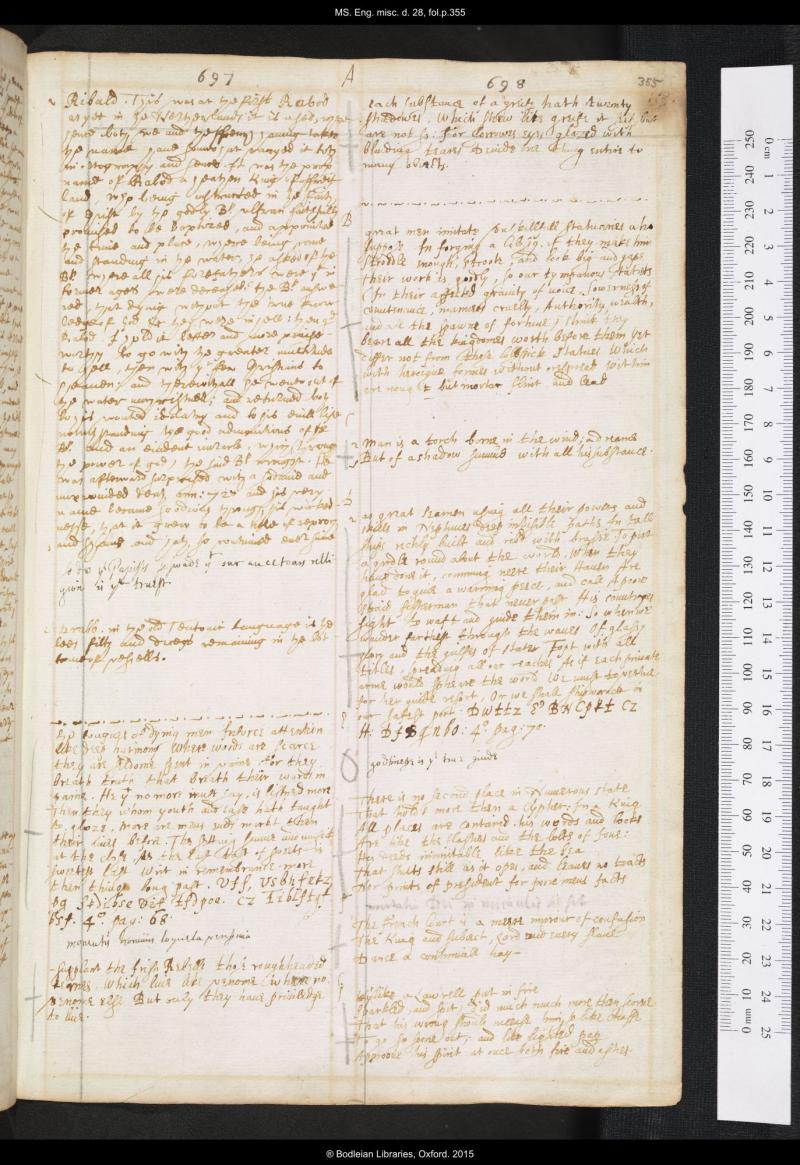
MS. Eng. misc. d.28, page 355

View Image Assets
MS. Eng. misc. d.28, page 355
Click image to enlarge

Institution Rights and Document Citation

Terms of use
The Bodleian Libraries, University of Oxford, has graciously contributed images of materials in its collections to Shakespeare Documented under the terms of a Creative Commons Attribution-NonCommercial 4.0 International licence.  Images used within the scope of these terms should cite the Bodleian Libraries as the source.  For any use outside the scope of these terms, visitors should contact Bodleian Libraries Imaging Services at imaging@bodleian.ox.ac.uk.

Document-specific information
Creator: [Samuel Radcliffe?]
Title: A common place book
Date: ca. 1622-1625
Repository: Bodleian Library, Oxford University, Oxford, UK
Call number and opening: MS. Eng. misc. d.28, pp. 355, 359 & 375

Semi-diplomatic transcription

[col. 697]

Ribald. This was at the first Rabod
as yet in the Nertherlands it is asea, where
hence both (we and the french) hauing taken
the name haue sence that varyed it both
in . . graphy and sence. It was the proper
name of Rabod a heathen King of ffreis
land, who being instructed in the faith
of christ by the godly Bishop vltran faithfully
promised to be baptized, and appointed
the time and place, where being come
and standing in the water, he asked of the
Bishop where all his forefathers were that in
former ages were deceased? the Bishop answer=
ed, that dying without the true know=
ledge of God &c they werein hell: then the
Rabod  I hold it better and more praise-
worthy to go with the greater multitude
to hell, then with your few Christians to
heauen; and therewithall he went out of
the water unchristned; and returned both
to his wonted idolatry and to his euill life
notwithstanding the good admonitions of the
Bishop and an euident miracle which (through
the power of god) the said Bishop wrought. He
was afterward surprised with a sodaine and
unprovided death anno 720 and his very
name became so odius through, his wicked
nesse, that it grew to be a tale of reproch
and shame and hath so continued euer since

so do the Papists perswade that our ancestors relli=
gion is the truest

D[?]rabb in the old Teutonic language is the
lees filth and dreges remaining in the bot-
tome of vesells.

the tongues of dying men Inforce attention
like deep harmony where words are scarce
they are seldome spent in vaine for they
breath truth that breath their words in
vaine. He that no more must say, is listened more
then they whom youth and ease hath taught
to gloze, more are mens ends markt then
their liues before. The setting sunne and musick
at the close. As the last tast of sweets is
sweetest last writ in remembrance more
then things long past.  vff, vsbhfekz
bg 3.di5se vif tfdpoe. cz Tiblftgt
bsf 4o. page 68

morientis hominis loquela vinsinua

supplant the first Rebells their roughheaded
cernes which liue like venome where no
venome else But only they haue priuiledge
to liue.

[col. 698]

each substance of a griefe hath twenty
shoedowes, which shew like greife it self, but
are not so: For sorrowes eyes glazed with
bleeding tears Deuide one thing entire to
many obiects. 

great men imitate / unskillfull statuaries who
suppose In forging a Colos.. if they make him
stroddle enough, stroote, and look big and gape
their work is goodly, so our tympanous statists
(In their affected grauity of voice, sowerness of
countenace, manners cruelty, Authority, wealth,
and all the spawne of fortune) think they
beare all the kingdomes worth before them yet
differ not from their Colosick statues which
with heroique formes without orespread within
are nou[h]t but mortar flint and lead

man is a torch borne in the wind; a dreame
But of a shadow summ’d with all his substance

as great seamen using all their powers and
skills in the Neptunes deep invisible paths in tall
ships richly built and ribd with brasse. To put
a girdle round about the world, when they
haue done it, comming neere their Hauen Are
glad to give a warning peece, and call A poore
staid fisherman that neuer past  His countryes
sight to waft and guide them in: So when we
wander farthest through the waues of glassy
glory and the gulfes of state Topt with all
titles, spreading all our reaches As if each priuate
arme would spheare the world   We must to vertue
for her guide resort, Or we shall shipwrack in
our safest port  DWttz Eo BNCpRt CZ
H: DIB Gnbo: 4o page 70

god…... is that true guide

There is no second place in Numerous state
that hold more then a Cypher: In a King
All places are containd. his words and looks
Are like that flashes and the bolts of Ioue:
His deeds inimitable like the Sea
that shuts still as it opes, and leaves no tractes
Nor prints of president for poor mens factes

The French Court is a meere mirrour of confusion
the King and Subiect, Lord and euery slaue
Dance a continuall hay

that (like a Lawrell put in fire
sparkled, and spit, did much much more than scorne
that his wrong should incense him so like chaffe
To go so soone out; and like lighted paper
Approoue his spirit at once both fire and ashes

Item Creator
[Samuel Radcliffe?]
Item Title
A common place book
Item Date
ca. 1622-1625
Repository
Bodleian Library, Oxford University, Oxford, UK
Call Number
MS. Eng. misc. d.28, p. 355

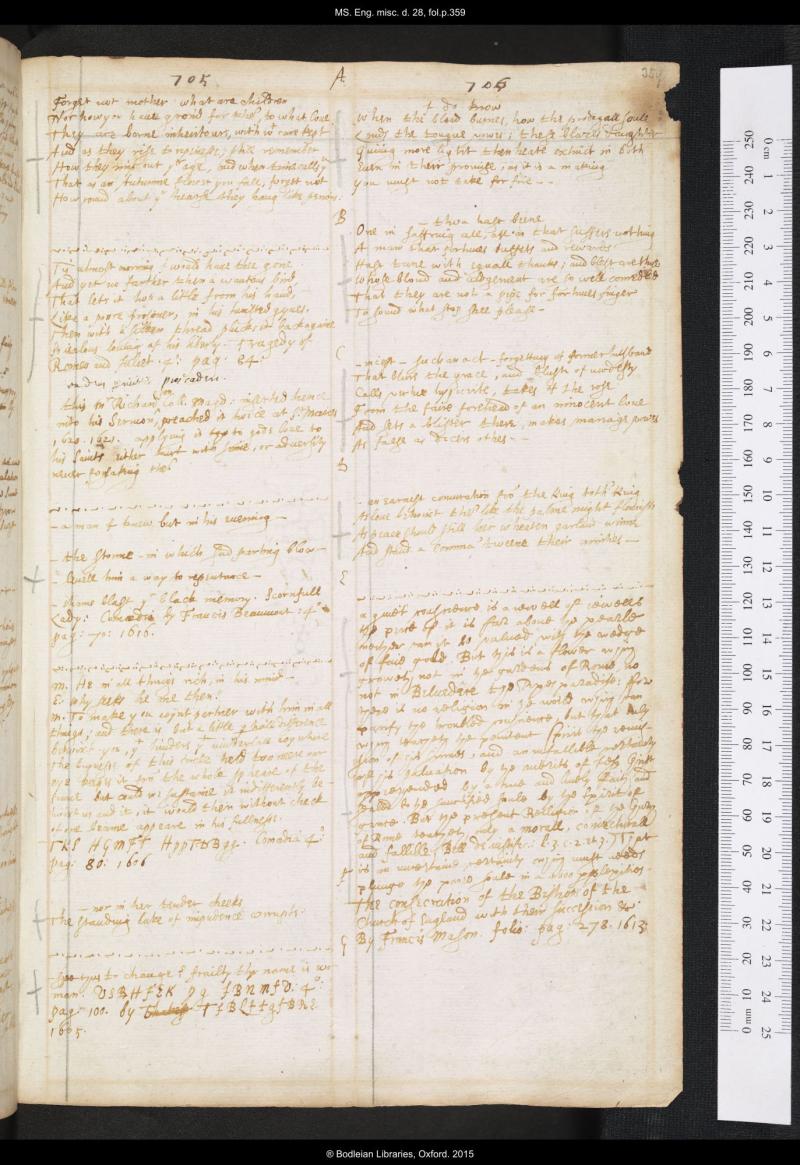
MS. Eng. misc. d.28, page 359

View Image Assets
MS. Eng. misc. d.28, page 359
Click image to enlarge

Institution Rights and Document Citation

Terms of use
The Bodleian Libraries, University of Oxford, has graciously contributed images of materials in its collections to Shakespeare Documented under the terms of a Creative Commons Attribution-NonCommercial 4.0 International licence.  Images used within the scope of these terms should cite the Bodleian Libraries as the source.  For any use outside the scope of these terms, visitors should contact Bodleian Libraries Imaging Services at imaging@bodleian.ox.ac.uk.

Document-specific information
Creator: [Samuel Radcliffe?]
Title: A common place book
Date: ca. 1622-1625
Repository: Bodleian Library, Oxford University, Oxford, UK
Call number and opening: MS. Eng. misc. d.28, pp. 355, 359 & 375

Semi-diplomatic transcription

[col. 705]

Forget not mother what are children
Nor how you haue gron’d for them, to what loue
they are borne inheritours, with what care kept
And as they rise to ripeness, still remember
How they imp out your age, and when time calls you
That as an Autumne flower you fall, forget not
How round about the hearse they hang like penons:

Tis almost morning I would haue thee gone
And yet no father then a wantons bird,
That lets it hop a little from his hand,
Like a poore prisoner, in his twisted gyues.
Then with a silken thread plucks it back againe
So jealous louing of his liberty. Tragedy of
Romeo and Iuliet .4o: page 84:

radius Amicitiae pios cadere

this Mr Richard^son College Magdalen inserted hence
into his semon, preached it twice as Saint Maries
1620.1621. applying it then to gods love to
his saints either hurt with sinne, or aduersity
neuer forsaking them.

- a man I knew but in his euening

- the storme in which sad parting blow
- leuell him a way to repentance
- shame blast your black memory. Scornfull
Lady: Comedia by Francis Beaumont: 4o
page 70: 1616

M[omford]. He in all things rich, in his mind
E[ugenia]: Why seeks he me then?
M[omford]. To make you ioynt partner with him in all
things; and there is but a little partiall difference
betwixt you that hinders that universall ioy where
the bignesse of this circle held too neere our
eye keepes it from the whole spheare of the
sunne but could we sustaine it indifferently be-
twixt us and it, it would then without check
of one beame appeare in his fullnesse.
TRP HGMFT HppTDBgg Comedia 4o:
page 80: 1606

- nor in her tender cheeks
the standing lake of impudence corrupts

shee thus to change & frailty they name is wo-
man. VSBHFEK pg IBNMfV: 4o:
page 100. by Shakes TIBLftgfBRE.
1605

[col. 706]

             I do know
when the blood burnes, how the prodigall soule
Lends the tongue vowes; these blazes daughter
giuing more light then heate extinct in both
euen in thier promise ; as it is a making
you must not take for fire--

           - thou hast been
One in suffring all, oft as that suffers nothing
A man that fortunes buffets and rewards
Hast tane with equall thankes; and blest are those
whose bloud and iudgement are so well comedled
That they are not a pipe for fortunes finger
To sound what stop shee please

- nicest - such an act - forgetting of former husband
That blurs the grace, and blush of modesty
calls virtue hypocrite, takes of the rose
From the faire forehead of an innocent loue
And sets a blister there, makes mariage vowes
As false as dicers othes

an earnest coniuration from the king to th’king
As loue betwixt them like the palme might flourish
As peace should still her wheaten garland winne
And stand a comma tweene their amities

a quiet conscience is a iewell of iewells
the price of it is far aboue the pearle
neither can it be valued with the wedge
of fine gold. But this is a flower which
groweth not in the gardens of Rome, no
not in Beluedere the Popes paradise: for
there is no religion in the world which can
pacify the troubled conscience, but that only
which teacheth the penitent spirit the remis-
sion of his sinnes, and an infallible certainty
of his saluation by the merits of Ies Christ
apprehended by a true and liuely faith and
sealed to the sanctified soule by the spirit of
grace. But the present Religion of the Church
of Rome teacheth only a morall, coniecturall
and fallible. Bell de iusti... : l.3.(.2.243.) That
it is uncertaine certainty which must needs
plunge the poor soule in a 1000 perplexities
The consecration of the Bishops of the
Church of England with their succesion &c.
By Francis Mason. folio: page 278 . 1613

Item Creator
[Samuel Radcliffe?]
Item Title
A common place book
Item Date
ca. 1622-1625
Repository
Bodleian Library, Oxford University, Oxford, UK
Call Number
MS. Eng. misc. d.28, p. 359

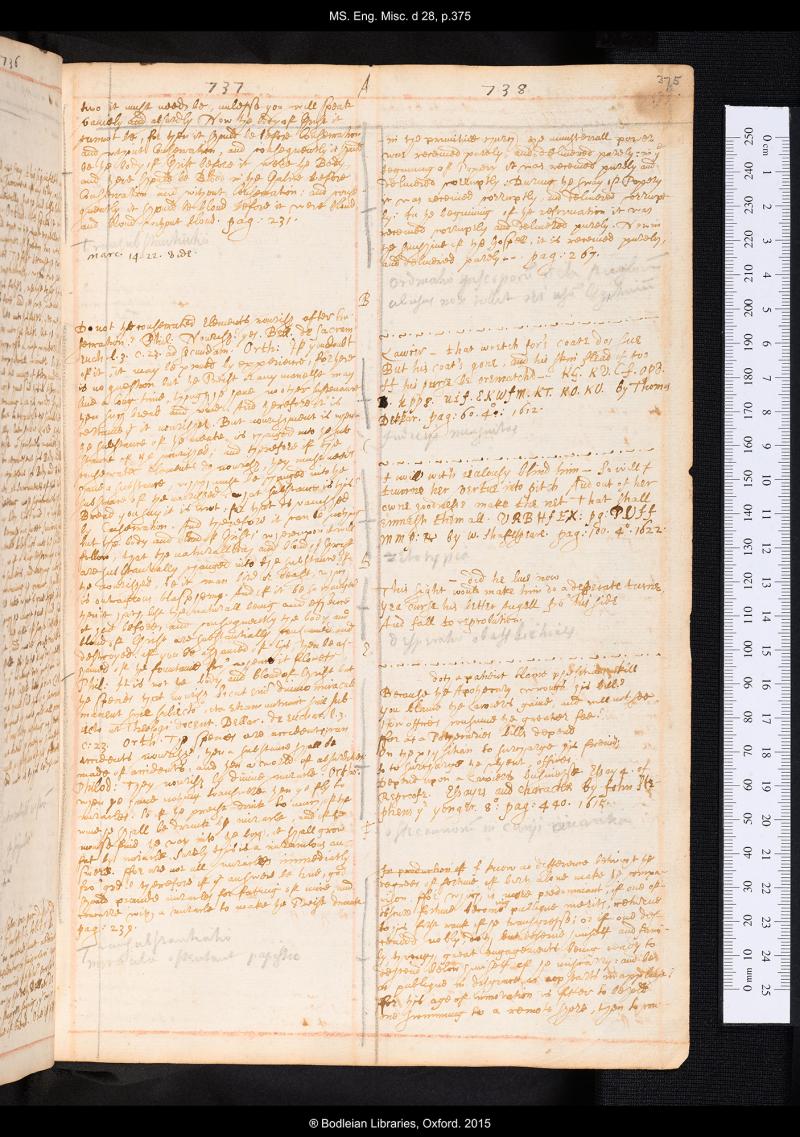
MS. Eng. misc. d.28, page 375

View Image Assets
MS. Eng. misc. d.28, page 375
Click image to enlarge

Institution Rights and Document Citation

Terms of use
The Bodleian Libraries, University of Oxford, has graciously contributed images of materials in its collections to Shakespeare Documented under the terms of a Creative Commons Attribution-NonCommercial 4.0 International licence.  Images used within the scope of these terms should cite the Bodleian Libraries as the source.  For any use outside the scope of these terms, visitors should contact Bodleian Libraries Imaging Services at imaging@bodleian.ox.ac.uk.

Document-specific information
Creator: [Samuel Radcliffe?]
Title: A common place book
Date: ca. 1622-1625
Repository: Bodleian Library, Oxford University, Oxford, UK
Call number and opening: MS. Eng. misc. d.28, pp. 355, 359 & 375

Item Creator
[Samuel Radcliffe?]
Item Title
A common place book
Item Date
ca. 1622-1625
Repository
Bodleian Library, Oxford University, Oxford, UK
Call Number
MS. Eng. misc. d.28, p. 375

Institution Rights and Document Citation

Semi-diplomatic transcription

Last updated June 9, 2020

John Aubrey's notes on Shakespeare

Document Images

MS Aubrey 8, folio 50 verso

View Image Assets
MS Aubrey 8, folio 50 verso
Click image to enlarge

Institution Rights and Document Citation

Terms of use
The Bodleian Libraries, University of Oxford, has graciously contributed images of materials in its collections to Shakespeare Documented under the terms of a Creative Commons Attribution-NonCommercial 4.0 International licence.  Images used within the scope of these terms should cite the Bodleian Libraries as the source.  For any use outside the scope of these terms, visitors should contact Bodleian Libraries Imaging Services at imaging@bodleian.ox.ac.uk.

Document-specific information
Creator: John Aubrey
Title: Brief Lives
Date: ca. 1679/1680
Repository: Bodleian Library, Oxford University, Oxford, UK
Call number and opening: MS. Aubrey 8, fol. 50v

Semi-diplomatic transcription

Editorial note: This entire page has been crossed out.                

                        Iohn Fletchr.                                      
Invited [^]to go with a knight in to Norfolke, or Suffolke int the Plagu time 1625
stayd but to make himselfe a Suite of cloathes fell sick
of the Plague Dyed.
             Iohn Ogilby        
after he had built the Theater at Dublin,
            He was undon at the Irish Rebellion
he was wreck’t at Sea and came to London very
poor & went on foot to Cambridge.
The more to be admired q[uia] he was not a company keeper
lived in Shoreditch, would n[o]t be debauched, & if invited to
gout: he was in paine
                           W. Shakespere                                                
q[uaere] Mr Beeston who knows most of him from Mr. Lacy
he lives in Shore-ditch. neer Nort at Hoglane
within 6 dores - Norton - folgate.
q[uaere] etiam for B. Jonson.
                            B. Jonson.
one eye lower then tother, & bigger
q[uaere] his description of a Trooper in English verse^very good [This line relates to a line about Ogilby on the other side of this leaf.]
He tooke a Catalaloge[sic] from Mr Lacy of the Yorkshire
dialectword - his hint to a Tale of a Tub
for the Clownery.

Item Date
ca. 1679/80
Repository
Bodleian Library, Oxford University, Oxford, UK
Call Number
MS Aubrey 8, fol. 50v

Institution Rights and Document Citation

Semi-diplomatic transcription

Last updated November 29, 2022

"Brief Lives" by John Aubrey: including "Mr. William Shakespeare."

Document Images

MS. Aubrey 6, folio 109 recto

View Image Assets
MS. Aubrey 6, folio 109 recto
Click image to enlarge

Institution Rights and Document Citation

Terms of use
The Bodleian Libraries, University of Oxford, has graciously contributed images of materials in its collections to Shakespeare Documented under the terms of a Creative Commons Attribution-NonCommercial 4.0 International licence.  Images used within the scope of these terms should cite the Bodleian Libraries as the source.  For any use outside the scope of these terms, visitors should contact Bodleian Libraries Imaging Services at imaging@bodleian.ox.ac.uk.

Document-specific information
Creator: John Aubrey
Title: Brief lives.
Date: 1679/1680
Repository: Bodleian Library, Oxford University, Oxford, UK
Call number and opening: MS. Aubrey 6, fol. 109r-v

Semi-diplomatic transcription

                                            Mr. William Shakespear.                        109            78              
                                         was borne at Stratford vpon Avon in the County of Warwic
                                         his father was a Butcher, & I haue been told heretofore by some
                                         of the neighbours that when he was a boy he exercised his fathers-
                                         Trade, but when he kill'd a Calfe he would doe it in a high style, &
                                         make a Speech. There was at that time another Butchers son in
                                         this Towne that was held not at all inferior to him for wi a naturall
                                         witt, his acquaintance & coetanean; but dyed young. This William
                                         being inclined naturally to Poetry and acting, came to London
                                         I guesse about 18: and was an Actor at one of the Play-houses
                                         and did acte exceedingly well: now Ben Iohnson was never
                                         a good Actor, but an excellent Instructor.  He began early to -
                                         make essayes at Dramatique Poetry, which at that time was very
                                         lowe; and his Playes tooke well: He was a handsome, well
                                         shap't man: very good company, and of a very readie and
                                         pleasant smooth Witt. The Humour of ……. the Constable
                                         in a Midsomersnight's Dreame, he happened to take at
*I thinke it was Mid-       *Grendon in Bucks which is the roade from London to Stratford
somer night that he-     
happened to lye there.     and there was living that Constable about 1642 when I
                                        first came to Avon. Mr Ios: Howe is of that parish and knew him.
                                        Ben Iohnson and he did gather Humours of men dayly
                                        where euer they came. One time as he was at the Tavern
                                        at Stratford super Avon, one Combes, an old rich Usurer
                                        was to be buryed. He makes there this extemporary Epitaph
                                                     Ten in the Hundred the Devill aIlowes
                                                     But Combes will haue twelue he sweares & vowes:
                                                     If any one askes who lies in this Tombe:
                                                     Hoh! quoth the Devill, 'Tis my Iohn o'Combe.
                                        He was wont to goe to his native Country once a yeare:
                                        I thinke I have been told that he left 2 or 300l per annum there
                                        and thereabout: to a sister. I have heard Sir William Dave-
V. his Epitaph                 -nant and Mr. Thomas Shadwell (who is counted the best Co-
in Dugdals Warw.           -moedian we have now) say that he had a most prodigious Witt,
                                        and did admire his naturall parts beyond all other Dramaticall
B. Iohnsons Vnder-         writers. He* was wont to say. That he never blotted out a line
- woods.                          in his life: sayd Beniamin Iohnson. I wish he had blotted out a thou-
                                        -sand. His Comoedies will be W repaire witt, as long as the English
                                        tongue is understood: where our for that he handles mores hominum: now
                                        our present writers reflect to much on particular persons, &
                                        coxcombeities,  that 20 yeares hence, they will not be understood.
                                        Though, as Ben Iohnson sayes of him. that he und had little Latine and
from Mr...Beeston.          lesse Greek; He understood Latine pretty well: for he had been in his younger
                                        yeares a Schoolmaster in the Countrey.

Item Creator
John Aubrey
Item Title
Brief lives.
Item Date
1679/80
Repository
Bodleian Library, Oxford University, Oxford, UK
Call Number
MS. Aubrey 6, fol.109r

MS. Aubrey 6, folio 109 verso

View Image Assets
MS. Aubrey 6, folio 109 verso
Click image to enlarge

Institution Rights and Document Citation

Terms of use
The Bodleian Libraries, University of Oxford, has graciously contributed images of materials in its collections to Shakespeare Documented under the terms of a Creative Commons Attribution-NonCommercial 4.0 International licence.  Images used within the scope of these terms should cite the Bodleian Libraries as the source.  For any use outside the scope of these terms, visitors should contact Bodleian Libraries Imaging Services at imaging@bodleian.ox.ac.uk.

Document-specific information
Creator: John Aubrey
Title: Brief lives.
Date: 1679/1680
Repository: Bodleian Library, Oxford University, Oxford, UK
Call number and opening: MS. Aubrey 6, fol. 109r-v

Semi-diplomatic transcription

                                    Moren of Sir Iohn Suckling
                                         My Lady Southcot. whose husband hanged himselfe,
                                         was Sir Iohn Sucklings sister, to whom he writes a consolato-
+ Dr. Corbet married       -ry letter viz: the first . She afterward maried ……+ Corbet D.D.
      Sir Nath. Brents        of Merton College oxon: at her house in Bishopsgate street London is
          daughter                an originall of her brother Sir John, of Sir Anthony van-
                                         Dyke, all at length leaning against a rock with a play papir
                                         -booke, contemplating. It is a piece of great value: there is
                                         also anothr rare picture, viz: of that pretty creature
                                         Mistress Iane Shore; an originall. / When his Aglaura was
                                         he bought all the Clouthes himselfe, which were very rich.
                                         no tinsill: all the lace pure gold and silver which cost him
                                         . . . . . . . . I haue now forgott: he had some scanes to it
                                         which these dayes were only used at masques. / Memorandum
                                         Mr Snowdon. tells me that after Sir Iohns unluckie ren-
                                         -counter, or Quarrell with Sir Iohn Digby, wherin he was-
                                         baffled: ‘twas strange to see the envie, and ill nature of
                                         people to trample, and scoffe at, and deject one in dis-
                                         -grace; inhumane as well as un-christian. The Lady
                                         . . . . Moray had made an entertainment for severall
                                         persons of quality at Ashley (in Surrey neer Chertsey)
                                         where^ at Mr Snowden then was. There was the Countesse
                                         of Middlesex, whom Sir Iohn had highly courted, and
                                         had spent on her & in treating her some thousand of
                                         pounds. At this entertainment she could not forbeare
                                         but was so severe, and ingrate as to upbraid Sir John
                                         of his late received Baffle: and some other Ladys,
                                         had their flirts. The Lady Moray (who invited them)
                                         seing Sir Iohn out of countenance, and for whse
                                         worth she alwaies had a respect. Come Well sayd shee
                                         I am a merry Wench, and will never for sake an
                                          old friend in disgrace: so come me sitt downe by me
                                         Sir John (said she) and seated him on her right hand:
                                         and countenanced him. this raysed Sir iohns dejected-
                                         spirites that he threw his reparties about the Table
                                         with so much sparklingnesse and Gentilenes of Witt,
                                         to the admiration of them all./

Item Creator
John Aubrey
Item Title
Brief lives.
Item Date
1679/80
Repository
Bodleian Library, Oxford University, Oxford, UK
Call Number
MS. Aubrey 6, fol. 109v

Institution Rights and Document Citation

Semi-diplomatic transcription

Last updated February 8, 2020

The Passionate Pilgrim, third edition

Document Images

Arch. G g.1, first title page

View Image Assets
Arch. G g.1, first title page
Click image to enlarge

Institution Rights and Document Citation

Terms of use
The Bodleian Libraries, University of Oxford, has graciously contributed images of materials in its collections to Shakespeare Documented under the terms of a Creative Commons Attribution-NonCommercial 4.0 International licence.  Images used within the scope of these terms should cite the Bodleian Libraries as the source.  For any use outside the scope of these terms, visitors should contact Bodleian Libraries Imaging Services at imaging@bodleian.ox.ac.uk.

Copy-specific information
Title: The passionate pilgrime, or, Certaine amorous sonnets, betweene Venus and Adonis
Date: [London] : Printed by W. Iaggard, 1612
Repository:  Bodleian Library, Oxford University, Oxford, UK
Call number and opening: Arch. G g.1, title pages
View online bibliographic record

Item Title
The passionate pilgrime, or, Certaine amorous sonnets, betweene Venus and Adonis
Item Date
[London] : Printed by W. Iaggard, 1612
Repository
Bodleian Library, Oxford University, Oxford, UK
Call Number
Arch. G g.1, first title page

Arch. G g.1, second title page

View Image Assets
Arch. G g.1, second title page
Click image to enlarge

Institution Rights and Document Citation

Terms of use
The Bodleian Libraries, University of Oxford, has graciously contributed images of materials in its collections to Shakespeare Documented under the terms of a Creative Commons Attribution-NonCommercial 4.0 International licence.  Images used within the scope of these terms should cite the Bodleian Libraries as the source.  For any use outside the scope of these terms, visitors should contact Bodleian Libraries Imaging Services at imaging@bodleian.ox.ac.uk.

Copy-specific information
Title: The passionate pilgrime, or, Certaine amorous sonnets, betweene Venus and Adonis
Date: [London] : Printed by W. Iaggard, 1612
Repository:  Bodleian Library, Oxford University, Oxford, UK
Call number and opening: Arch. G g.1, title pages
View online bibliographic record

Item Title
The passionate pilgrime, or, Certaine amorous sonnets, betweene Venus and Adonis
Item Date
[London] : Printed by W. Iaggard, 1612
Repository
Bodleian Library, Oxford University, Oxford, UK
Call Number
Arch. G g.1, second title page

Institution Rights and Document Citation

Last updated January 25, 2020

Manuscript promptbook of The Second Maiden’s Tragedy: misattributed to Shakespeare

Document Images

Lansdowne MS 807, folio 29 recto

View Image Assets
Lansdowne MS 807, folio 29 recto
Click image to enlarge

Institution Rights and Document Citation

From the collections of: THE BRITISH LIBRARY

Terms of use
The British Library has graciously contributed the above images to Shakespeare Documented under a Creative Commons Public Domain Mark.

Copyright status of the manuscript and unpublished Materials: The 1988 Copyright, Designs and Patents Act (as amended) states that unpublished literary and artistic works remain in copyright in the UK until at least 31 December 2039. Therefore important parts of the library’s collection remain in copyright, including very old manuscripts. However for unpublished material created many centuries ago and in the public domain in most other countries, the Library believes this material to be very unlikely to offend anyone. As an institution whose role it is to support access to knowledge, we have therefore taken the decision to release certain digitised images technically still in copyright in the UK under the Public Domain Mark.

Document-specific information
Title: folio.A Volume, formerly belonging to John Warburton, Esq. Somerset Herald, containing 5 plays
Date: 1558-1642
Repository: The British Library, London, UK
Call number and opening: Lansdowne MS 807
View online bibliographic record

Item Title
folio.A Volume, formerly belonging to John Warburton, Esq. Somerset Herald, containing 5 plays
Item Date
1558-1642
Repository
The British Library, London, UK
Call Number
Lansdowne MS 807, fol. 29r

Lansdowne MS 807, folio 56 recto

View Image Assets
Lansdowne MS 807, folio 56 recto
Click image to enlarge

Institution Rights and Document Citation

From the collections of: THE BRITISH LIBRARY

Terms of use
The British Library has graciously contributed the above images to Shakespeare Documented under a Creative Commons Public Domain Mark.

Copyright status of the manuscript and unpublished Materials: The 1988 Copyright, Designs and Patents Act (as amended) states that unpublished literary and artistic works remain in copyright in the UK until at least 31 December 2039. Therefore important parts of the library’s collection remain in copyright, including very old manuscripts. However for unpublished material created many centuries ago and in the public domain in most other countries, the Library believes this material to be very unlikely to offend anyone. As an institution whose role it is to support access to knowledge, we have therefore taken the decision to release certain digitised images technically still in copyright in the UK under the Public Domain Mark.

Document-specific information
Title: folio.A Volume, formerly belonging to John Warburton, Esq. Somerset Herald, containing 5 plays
Date: 1558-1642
Repository: The British Library, London, UK
Call number and opening: Lansdowne MS 807
View online bibliographic record

Item Title
folio.A Volume, formerly belonging to John Warburton, Esq. Somerset Herald, containing 5 plays
Item Date
1558-1642
Repository
British Library, London, UK
Call Number
Lansdowne MS 807, fol. 56r

Lansdowne MS 807, folio 56 verso

View Image Assets
Lansdowne MS 807, folio 56 verso
Click image to enlarge

Institution Rights and Document Citation

From the collections of: THE BRITISH LIBRARY

Terms of use
The British Library has graciously contributed the above images to Shakespeare Documented under a Creative Commons Public Domain Mark.

Copyright status of the manuscript and unpublished Materials: The 1988 Copyright, Designs and Patents Act (as amended) states that unpublished literary and artistic works remain in copyright in the UK until at least 31 December 2039. Therefore important parts of the library’s collection remain in copyright, including very old manuscripts. However for unpublished material created many centuries ago and in the public domain in most other countries, the Library believes this material to be very unlikely to offend anyone. As an institution whose role it is to support access to knowledge, we have therefore taken the decision to release certain digitised images technically still in copyright in the UK under the Public Domain Mark.

Document-specific information
Title: folio.A Volume, formerly belonging to John Warburton, Esq. Somerset Herald, containing 5 plays
Date: 1558-1642
Repository: The British Library, London, UK
Call number and opening: Lansdowne MS 807
View online bibliographic record

Item Title
folio.A Volume, formerly belonging to John Warburton, Esq. Somerset Herald, containing 5 plays
Item Date
1558-1642
Repository
The British Library, London, UK
Call Number
Lansdowne MS 807, fol. 56v

Institution Rights and Document Citation

Semi-diplomatic transcription

Last updated May 17, 2020

Forman's account of seeing plays at the Globe: Macbeth, Cymbeline, Winter's Tale

Document Images

MS Ashmole 208, folio 200 recto

View Image Assets
MS Ashmole 208, folio 200 recto
Click image to enlarge

Institution Rights and Document Citation

Terms of use
The Bodleian Libraries, University of Oxford, has graciously contributed images of materials in its collections to Shakespeare Documented under the terms of a Creative Commons Attribution-NonCommercial 4.0 International licence.  Images used within the scope of these terms should cite the Bodleian Libraries as the source.  For any use outside the scope of these terms, visitors should contact Bodleian Libraries Imaging Services at imaging@bodleian.ox.ac.uk.

Document-specific information
Creator: Simon Forman
Title: The Bocke of Plaies and Notes therof per forman for Common Pollicie
Date: 1611
Repository: Bodleian Library, Oxford University, Oxford, UK
Call number and opening: MS Ashmole 208, fol. 200-207v 

Modernized/Translated transcription

[fol. 200r]

The Book of Plays and Notes thereof, per Forman's, for Common Policy

Semi-diplomatic transcription

[fol. 200]

The Bocke of Plaies and

Notes therof per formans /

for Common Pollicie

Item Creator
Simon Forman
Item Title
The Bocke of Plaies and Notes therof per forman for Common Pollicie
Item Date
1611
Repository
Bodleian Library, Oxford University, Oxford, UK
Call Number
MS Ashmole 208, fol. 200r

MS Ashmole 208, folio 201 recto

View Image Assets
MS Ashmole 208, folio 201 recto
Click image to enlarge

Institution Rights and Document Citation

Terms of use
The Bodleian Libraries, University of Oxford, has graciously contributed images of materials in its collections to Shakespeare Documented under the terms of a Creative Commons Attribution-NonCommercial 4.0 International licence.  Images used within the scope of these terms should cite the Bodleian Libraries as the source.  For any use outside the scope of these terms, visitors should contact Bodleian Libraries Imaging Services at imaging@bodleian.ox.ac.uk.

Document-specific information
Creator: Simon Forman
Title: The Bocke of Plaies and Notes therof per forman for Common Pollicie
Date: 1611
Repository: Bodleian Library, Oxford University, Oxford, UK
Call number and opening: MS Ashmole 208, fol. 200-207v 

Modernized/Translated transcription

[fol. 201r]

In Richard the 2 at the Globe 1611 the 30 of April, Tuesday

Remember therein how Jack Straw by his overmuch boldness, not being politic nor suspecting anything, was suddenly at Smithfield Bars stabbed by Walworth, the mayor of London, so he and his whole Army was overthrown. Therefore in such a case or the like, never admit any party without a bar between, for a man cannot be too wise, nor keep himself too safe.

Also remember how the Duke of Gloucester, the Earl of Arundel, Oxford, and others, crossing the king in his humor about the Duke of Erland and Bushy, were glad to fly and raise a host of men. And being in his castle, how the Duke of Erland came by night to betray him with 300 men, but having privy warning thereof, kept his gates fast and would not suffer the enemy to enter, which went back again with a fly in his ear, and after was slain by the Earl of Arundel in the battle.

Remember also: when the duke and Arundel came to London with their army, King Richard came forth to them and met them and gave them fair words. And promised them pardon and that all should be well if they would discharge their army. Upon whose promises and fair speeches they did it, and after the king bid them all to a banquet and so betrayed them and cut off their heads etc., because they had not his pardon under his hand and seal before, but his word.

Semi-diplomatic transcription

[fol. 201r]

In Richard the 2 At the glob

1611 the 30 of Aprill / [planetary symbol for Tuesday]

Remember therin howe Iack strawe by his overmoch

boldnes not beinge pollitick nor suspecting Anye

thinge. was Soddenly at Smithfeld Bars

stabbed by Walworth the maior of London

soe he and his wholle Army was overthrowen

Therefore in such a case or the like, never ad

mit any party without a bar betwen for A man

Cannot be to wise, nor kepe him selfe to safe.

Also remember howe the duke of gloster. The Erell

of Arundell Oxford and others. crossing the kinge

in his humor. about the duke of Erland and Bushy

wer glad to fly and Raise an hoste of men. and

beinge in his Castell. howe the D of Erland cam by

nighte to betray him wit300 men. but hauinge

pryuie warninge ther of kept his gates faste

And wold not suffer, the Enimie to Enter, which

went back Again with a flie in his eare. and after

was slainte by the Errell of Arundell in the battell

Remember also: when the duke and Arundell cam to

London with their Army. kinge Richard came forth to

them and met them and gaue them fair wordes. And

promised them pardon and that all should be

well yf they wold discharge their Army. Vpon.

whose promises and faier Speaches they did yt and

Affter the king byd them all to A banket and soe

betraid them And Cut of their heades &c because

they had not his pardon vnder his hand & sealle be

fore but his worde/

Item Creator
Simon Forman
Item Title
The Bocke of Plaies and Notes therof per forman for Common Pollicie
Item Date
1611
Repository
Bodleian Library, Oxford University, Oxford, UK
Call Number
MS Ashmole 208, fol. 201r

MS Ashmole 208, folio 201 verso

View Image Assets
MS Ashmole 208, folio 201 verso
Click image to enlarge

Institution Rights and Document Citation

Terms of use
The Bodleian Libraries, University of Oxford, has graciously contributed images of materials in its collections to Shakespeare Documented under the terms of a Creative Commons Attribution-NonCommercial 4.0 International licence.  Images used within the scope of these terms should cite the Bodleian Libraries as the source.  For any use outside the scope of these terms, visitors should contact Bodleian Libraries Imaging Services at imaging@bodleian.ox.ac.uk.

Document-specific information
Creator: Simon Forman
Title: The Bocke of Plaies and Notes therof per forman for Common Pollicie
Date: 1611
Repository: Bodleian Library, Oxford University, Oxford, UK
Call number and opening: MS Ashmole 208, fol. 200-207v 

Modernized/Translated transcription

[fol. 201v]

Remember therein also how the Duke of Lancaster privily contrived all villany, to set them all together by the ears and to make the nobility to envy the king and mislike of him and his governments by which means he made his own son king, which was Henry Bolingbroke.

Remember also how the Duke of Lancaster asked a wise man, whether himself should ever be king and he told him no, but his son should be a king. And when he had told him he hanged him up for his labor, because he should not brute it abroad or speak thereof to others. This was a policy in the commonwealth's opinion. But I say it was a villain's part and a Judas's kiss to hang the man for telling him the truth. Beware by this example of noble men and of their fair words and say little to them, lest they do the like by thee for thy good will. 

In the Winter's Tale at the Globe

1611 the 15 of May, Wednesday

Observe there how Leontes the king of Sicilia was overcome with jealousy of his wife with the king of Bohemia, his friend that came to see him; and how he contrived his death and would have had his cupbearer to have poisoned, who gave the king of Bohemia warning thereof and fled with him to Bohemia. 

Remember also how he sent to the Oracle of Apollo and the answer of Apollo, that she was guiltless and that the king was jealous, etc., and how except the child was found again that was lost, the king should die without issue. For the child was carried into Bohemia and there laid in a forest and brought up by a shepherd

Semi-diplomatic transcription

[fol. 201v]

Remember therin Also howe the ducke of Lankaster

pryuily contryued all Villany. to set them all to

gether by the ears and to make the nobilyty to

Envy the kinge and mislyke of him and his gouern

mentes by which means. he made his own sonn

king which was henry Bullinbrocke

Remember also howe the duke of Lankaster asked

A wise man, wher him self should ever be kinge

And he told him no, but his sonn should be a

kinge. And when he had told him he hanged

him vp for his labor. because he should not

brute yt a brod or speke ther of to others. This

was a pollicie in the common wealthes opinion

But I sai yt was a Villains parte and a Iudas

kisse to hange the man. for telling him the truth

Beware by this Example of noble men / and of

their fair wordes & sai lyttell to them, lest they

doe the like by thee for thy good will/


In the Winters Talle at the glob

1611 the 15 of maye [planetary symbol for Wednesday]

Obserue ther howe Lyontes the kinge of Cicillia was

overcom with Ielosy of his wife with the kinge of Bo

hemia his Frind that came to see him. and howe he

Contriued his death and wold haue had his cup

berer to haue poisoned. Who gaue the king of bohe

mia warning ther of & fled with him to bohemia/

Remember also howe he sent to the Orakell of appollo

& the Aunswer of apollo. that she was giltles. and

that the king was Ielouse &c and howe Except the

Child was found Again that was loste the kinge should

die with out yssue. for the Child was caried into bohemia

& ther laid in a forrest & brought vp by a sheppard

and

Item Creator
Simon Forman
Item Title
The Bocke of Plaies and Notes therof per forman for Common Pollicie
Item Date
1611
Repository
Bodleian Library, Oxford University, Oxford, UK
Call Number
MS Ashmole 208, fol. 201v

MS Ashmole 208, folio 202 recto

View Image Assets
MS Ashmole 208, folio 202 recto
Click image to enlarge

Institution Rights and Document Citation

Terms of use
The Bodleian Libraries, University of Oxford, has graciously contributed images of materials in its collections to Shakespeare Documented under the terms of a Creative Commons Attribution-NonCommercial 4.0 International licence.  Images used within the scope of these terms should cite the Bodleian Libraries as the source.  For any use outside the scope of these terms, visitors should contact Bodleian Libraries Imaging Services at imaging@bodleian.ox.ac.uk.

Document-specific information
Creator: Simon Forman
Title: The Bocke of Plaies and Notes therof per forman for Common Pollicie
Date: 1611
Repository: Bodleian Library, Oxford University, Oxford, UK
Call number and opening: MS Ashmole 208, fol. 200-207v 

Modernized/Translated transcription

[fol. 202r]

and the king of Bohemia his son married that wench. And how they fled into Sicilia to Leontes, and the shepherd having showed the letter of the nobleman by whom Leontes sent was that child, and [by] the jewels found about her, she was known to be Leontes's daughter, and was then 16 years old. 

Remember also the rogue that came in all tattered like colt pixie, and how he feigned him sick and to have been robbed of all that he had and how he cozened the poor man of all his money, and after came to the sheep-shearer with a pedlar's pack and there cozened them again of all their money. And how he changed apparel with the king of Bohemia his son, and then how he turned courtier, etc. Beware of trusting feigned beggars or fawning felons. 

Semi-diplomatic transcription

[fol. 202r]

And the kinge of bohemia his sonn maried that wentch [sic]

& howe they fled into Cicillia to Leontes. and the

sheppard hauing showed the letter of the noble man

by whom Leontes sente was that child and the Ie

wells found about her. she was knowen to be leon

tes daughter and was then 16 yers old

Remember also the Rog[ue] that cam in all tottered like coll

pixci /. and howe he feyned him sicke & to haue bin Robbed

of all that he had and howe he cosoned the por man of all

his money. and after cam to the shep sher with a ped

lers packe & ther cosoned them Again of all their money

And howe he changed apparrell with the kinge of bomia [sic]

his sonn. and then howe he turned Courtiar &c/

beware of trustinge feined beggars or fawninge fellonse


Item Creator
Simon Forman
Item Title
The Bocke of Plaies and Notes therof per forman for Common Pollicie
Item Date
1611
Repository
Bodleian Library, Oxford University, Oxford, UK
Call Number
MS Ashmole 208, fol. 202r

MS Ashmole 208, folio 206 recto

View Image Assets
MS Ashmole 208, folio 206 recto
Click image to enlarge

Institution Rights and Document Citation

Terms of use
The Bodleian Libraries, University of Oxford, has graciously contributed images of materials in its collections to Shakespeare Documented under the terms of a Creative Commons Attribution-NonCommercial 4.0 International licence.  Images used within the scope of these terms should cite the Bodleian Libraries as the source.  For any use outside the scope of these terms, visitors should contact Bodleian Libraries Imaging Services at imaging@bodleian.ox.ac.uk.

Document-specific information
Creator: Simon Forman
Title: The Bocke of Plaies and Notes therof per forman for Common Pollicie
Date: 1611
Repository: Bodleian Library, Oxford University, Oxford, UK
Call number and opening: MS Ashmole 208, fol. 200-207v 

Modernized/Translated transcription

[fol. 206r]

Of Cymbeline, King of England

Remember also the story of Cymbeline, king of England in Lucius's time: how Lucius came from Octavius Caesar for tribute and being denied, after sent Lucius with a great army of soldiers who landed at Milford Haven, and after were vanquished by Cymbeline, and Lucius taken prisoner, and all by means of 3 outlaws of the which 2 of them were the sons of Cymbeline stolen from him when they were but 2 years old by an old man whom Cymbeline banished, and he kept them as his own sons 20 years with him in a cave. And how of them slew Clotan that was the queen's son going to Milford Haven to seek the love of Innogen, the king's daughter, whom he had banished also for loving his daughter. And how the Italian, that came from her love, conveyed himself into a chest and said it was a chest of plate sent from her love and others to be presented to the king. And in the deepest of the night she being asleep, he opened the chest and came forth of it, and viewed her in her bed and the marks of her body and took away her bracelet, and after accused her of adultery to her love, etc.

And in the end how he came with the Romans into England and was taken prisoner and after revealed to Innogen, who had turned herself into man's apparel and fled to meet her love at Milford Haven and chanced to fall on the cave in the woods where her 2 brothers were, and how by eating a sleeping dram they thought she had been dead and laid her in the woods and the body of Cloten by her in her love's apparel that he left behind him and how she was found by Lucius, etc.

Semi-diplomatic transcription

[fol. 206r]

of Cimbalin king of England

Remember also the storri of Cymbalin King

of England in Lucius tyme howe lucius

Cam from octauus Cesar for Tribut and

being denied. after sent Lucius with a greate

Arme of Souldiars who landed at milford

hauen. and Affter wer vanquished by Cim=

balin/ and Lucius taken prisoner and all

by means of 3 outlawes of the which 2 of them

were the sonns of Cimbalin stolen from

him when they were but 2 yers old. by an

old man whom Cymbalin banished. and

he kept them as his own sonns 20 yers with

him in A cave. And howe of of [sic] them slewe

Clotan that was the quens sonn goinge

To milford hauen to seke the loue of Innogen

the kinges daughter whom he had banished also

for louing his daughter. and howe the Italian

that cam from her loue. conveied him self

into A Cheste and said yt was a chest of plate

sent from her loue & others to be presented to the

Kinge. And in the depest of the night she be

ing aslepe. he opened the cheste & cam forth

of yt. And vewed her in her bed and the

markes of her body. & toke a wai her braslet

& after Accused her of adultery to her loue &c

And in thend howe he came with the Romaines into

England & was taken prisoner and after

Reveled to Innogen. who had turned her

self into mans apparrell & fled to mete

her loue at milford hauen & chanchsed to

fall on the Caue in the wodes wher her 2

brothers were & howe by eating a sleping

Dram they thought she had bin deed & laid

her in the wodes & the body of cloten by her.

in her loues apparrell that he left behind him

& howe she was found by lucius &c.

 
Item Creator
Simon Forman
Item Title
The Bocke of Plaies and Notes therof per forman for Common Pollicie
Item Date
1611
Repository
Bodleian Library, Oxford University, Oxford, UK
Call Number
MS Ashmole 208, fol. 206r

MS Ashmole 208, folio 207 recto

View Image Assets
MS Ashmole 208, folio 207 recto
Click image to enlarge

Institution Rights and Document Citation

Terms of use
The Bodleian Libraries, University of Oxford, has graciously contributed images of materials in its collections to Shakespeare Documented under the terms of a Creative Commons Attribution-NonCommercial 4.0 International licence.  Images used within the scope of these terms should cite the Bodleian Libraries as the source.  For any use outside the scope of these terms, visitors should contact Bodleian Libraries Imaging Services at imaging@bodleian.ox.ac.uk.

Document-specific information
Creator: Simon Forman
Title: The Bocke of Plaies and Notes therof per forman for Common Pollicie
Date: 1611
Repository: Bodleian Library, Oxford University, Oxford, UK
Call number and opening: MS Ashmole 208, fol. 200-207v 

Modernized/Translated transcription

[fol. 207r]

In Macbeth at the Globe 1610 the 20 of April, Saturday

There was to be observed first how Macbeth and Banquo, 2 noblemen of Scotland, riding through a wood, there stood before them 3 women fairies or nymphs, and saluted Macbeth, saying 3 times unto him, "Hail Macbeth, king of Codon [thane of Cawdor], for thou shall be a king but shall beget no kings," etc. Then said Banquo, "What, all to Macbeth, and nothing to me?" There said the nymphs, "Hail to thee, Banquo, thou shall beget kings, yet be no king." And so they departed and came to the court of Scotland to Duncan, king of Scots, and it was in the days of Edward the Confessor, and Duncan bade them both kindly welcome, and made Macbeth forthwith Prince of Northumberland, and sent him home to his own castle and appointed Macbeth to provide for him for he would sup with him the next day at night. And did so. And Macbeth contrived to kill Duncan, and through the persuasion of his wife did that night murder the king in his own castle being his guest. And there were many prodigies seen that night and the day before. And when Macbeth had murdered the king, the blood on his hands could not be washed off by any means, nor from his wife's hands which handled the bloody daggers in hiding them. By which means they became both much amazed and affronted. The murder being known, Duncan's 2 sons fled, the one to England, the

Semi-diplomatic transcription

[fol. 207r]

In Mackbeth at the glod 1610 the 20

of Aprill [planetary symbol for Saturday]. ther was to be obserued firste

howe Mackbeth and Bancko 2 noblemen

of Scotland Ridinge thorowe a wod the [sic] stode

befor them 3 women feiries or Nimiphes [sic]

And saluted Mackbeth sayinge .l. 3 tyms

vnto him. haille Mackbeth. king of Codon

for thou shalt be a kinge but shalt beget

No kinges &c. then said Bancko What all

to Mackbeth And nothing to me ther

said the nimphes haille to thee Banko

thou shalt beget kinges. yet be no kinge

And so they departed & cam to the Courte

of Scotland to Dunkin king of Scotes

and yt was in the dais of Edward the

Confessor. And Dunkin bad them both kind

ly wellcom. And made Mackbeth forth

with Prince of Northumberland. and

sent him hom to his own castell and ap

pointed mackbeth to prouid for him for

he wold Sup with him the next dai at

night. & did soe. And mackebeth contri

ved to kill Dunckin. & thorowe the persuasi

on of his wife did that night Murder

the kinge in his own Castell beinge his guest

And ther were many prodigies seen that

night & the dai before. And when Mack

Beth had murdred the kinge the blod on

his handes could not be washed of by Any

means. nor from his wiues handes which

handled the bluddi daggers in hiding them

By which meanes they became both moch ama

zed & Affronted. the murder being knowen

Dunckins 2 sonnes fled the on to England

the

Item Creator
Simon Forman
Item Title
The Bocke of Plaies and Notes therof per forman for Common Pollicie
Item Date
1611
Repository
Bodleian Library, Oxford University, Oxford, UK
Call Number
MS Ashmole 208, fol. 207r

MS Ashmole 208, folio 207 verso

View Image Assets
MS Ashmole 208, folio 207 verso
Click image to enlarge

Institution Rights and Document Citation

Terms of use
The Bodleian Libraries, University of Oxford, has graciously contributed images of materials in its collections to Shakespeare Documented under the terms of a Creative Commons Attribution-NonCommercial 4.0 International licence.  Images used within the scope of these terms should cite the Bodleian Libraries as the source.  For any use outside the scope of these terms, visitors should contact Bodleian Libraries Imaging Services at imaging@bodleian.ox.ac.uk.

Document-specific information
Creator: Simon Forman
Title: The Bocke of Plaies and Notes therof per forman for Common Pollicie
Date: 1611
Repository: Bodleian Library, Oxford University, Oxford, UK
Call number and opening: MS Ashmole 208, fol. 200-207v 

Modernized/Translated transcription

[fol. 207v]

[other to] Wales to save themselves. They being fled they were supposed guilty of the murder of their father, which was nothing so. Then was Macbeth crowned king, and then he, for fear of Banquo, his old companion, that he should beget kings but be no king himself, he contrived the death of Banquo and caused him to be murdered on the way as he rode. The next night being at supper with his noblemen, whom he had bid to a feast (to the which also Banquo should have come), he began to speak of noble Banquo and to wish that he were there. And as he thus did, standing up to drink a carouse to him, the ghost of Banquo came and sat down in his chair behind him. And he turning about to sit down again saw the ghost of Banquo which fronted him so that he fell into a great passion of fear and fury, uttering many words about his murder, by which when they heard that Banquo was murdered they suspected Macbeth.

Then Macduff fled to England to the king's son, and so they raised an army and came into Scotland, and at Dunsinane overthrew Macbeth. In the meantime, while Macduff was in England, Macbeth slew Macduff's wife and children, and after, in the battle, Macduff slew Macbeth. Observe also how Macbeth's queen did rise in the night in her sleep and walk and talked and confessed all, and the doctor noted her words.

Semi-diplomatic transcription

[fol. 207v]

[other to] Walles to saue them selues. they beinge

fled they were supposed guilty of the mur

der of their father which was nothinge soe

Then was Mackbeth. Crowned kinge

and then he for feare of Banko his old

Companion that he should beget kinges

but be no kinge him self. he contriued

the death of Banko and caused him

to be Murdred on the way as he Rode

The next night beinge at supper with

his noble Men whom he had bid to a

feaste to the which also Bancco should haue

com.) he began to speake of Noble Ba

nco and to wish that he wer ther. And

as he thus did standing vp to drincke a

Carouse to him. the ghoste of Banco

came and sate down in his cheier be

hind him. And he turninge About to

sit down Again sawe the goste of banco

which fronted him so. that he fell in to a

great passion of fear & fury. Vtteringe

many wordes about his murder by which

when they hard that Banco was Murdred

they Suspected Mackbet.

Then Mack Dove fled to England to the kinges

sonn. and soe they Raised an Army And cam

into scotland. and at dunston Anyse over

thrue Mackbet. In the meantyme whille

Mackdoue was in England Mackbet slewe

Mackdoues wife & children. and after in

the battelle Mackdoue slewe Mackbet.

Obserue Also howe Mackbetes quen did Rise in

the night in her slepe & walke and talked and

confessed all & the docter noted her wordes.

Item Creator
Simon Forman
Item Title
The Bocke of Plaies and Notes therof per forman for Common Pollicie
Item Date
1611
Repository
Bodleian Library, Oxford University, Oxford, UK
Call Number
MS Ashmole 208, fol. 207v

Institution Rights and Document Citation

Modernized/Translated transcriptions

Semi-diplomatic transcription

Last updated May 17, 2020

Shakespeare's arms defended: the Bodleian Library's copy of Garter and Clarenceux's reply to the York herald

Document Images

MS. Ashmole 846, folio 50 recto

View Image Assets
MS. Ashmole 846, folio 50 recto
Click image to enlarge

Institution Rights and Document Citation

Terms of use
The Bodleian Libraries, University of Oxford, has graciously contributed images of materials in its collections to Shakespeare Documented under the terms of a Creative Commons Attribution-NonCommercial 4.0 International licence.  Images used within the scope of these terms should cite the Bodleian Libraries as the source.  For any use outside the scope of these terms, visitors should contact Bodleian Libraries Imaging Services at imaging@bodleian.ox.ac.uk.

Document-specific information
Title: "The answeres of Garter and Clarencieux Kings of arms, to the scrowle of arms exhibited by Raffe Brookesmouth caled York Herauld."
Date: 1602
Repository: Bodleian Library, Oxford University, Oxford, UK
Call number and opening: MS. Ashmole 846, fol. 50r-v, and fol. 51v

Semi-diplomatic transcription

The answeres of Garter and Clarenceux Kings of Arms to the
Scrowle of Arms exhibited by Raffe Brokesmouth called York Herauld

The exceptions in the Scrowle of xxiij Arms exhibited doth Concerne ether the Arms
or the personns that beare the same. (Whom he hathe so iniuriously defamed.) In bothe wee hope to
satisfie your honorable lordships in particuler. Yf with your favorable leave wee may present vnto your
Grave Considerations the ancyent and manifould proofes that the Blazon and gevinge
of Arms perteinethe vnto our offices. The Authorite wherof by Custome is confirmed
in those Ordinary Wordes Iuxta Antiquam consuetudinem. conteyned in the great Seale
of England. Whiche wee can prove have ben graunted and allowed by the most
prudent and famous Prynces Kinge Henry .7. and Kinge Henry .viijth vnder bothe theyre
handes and Seales. That Garter also shall have the Corection & allowance of All Arms
thoroughe all England and the kinges dominions And to graunt Arms & Enseignes and to
make his Lettres patentes therevppon accordinge to the ^Byle[?] of the Statutes and Ordonances of the most noble Order
of the Garter. The decrees of the Constables & England doe declare the same And the
Custome continewed for the tyme of Sir William Bruges first Garter. Sir Iohn and Sir Thomas
Wrythesley SiChristofer Barker. and late Sir Gilbert Detheck. knight as all suche as have ben
Clarencieux dothe manifest the same. As well to personns Spirituall advaunced to dign[i]tes As
personns Temporall for theyre services in Warrs or offices & degres of honor. Riches or possessions
hable to maynteyne the same. Relienge vppon the promisses & the Queenes Maiesties great
Seale of England. Wee doe conceave most inward grieffe. for the exceptions taken herein
for xxiij Arms more then for xxiij hundred late geven by others. And wheras vnder her
Maiesties most happie governement hathe breed. in lieu of many extincte.) many worthye
personns qualefied to beare Arms. ffrom whom no doubt great personns shall aryse that
must deduce theyre originall descentes from the memories of the places & seruices
whiche theyre Parentes held in tyme of her Maiesties Reigne. For it is said Qui
nunc Novj videntur erunt Vetustissimj

Norton: [Norton coat of arms in left margin]
Co. Marche: [Mortimer coat of arms and another similar coat in right margin]

nota. Segar procurat
This patent Recalled.

This Coate is not deduced from the Arms of Mortimer Earle of March. As
he informethe. But is different bothe in Coullors. nomber of Barrs
and the Cantons Gironnes  And be it remembred that in those tymes when
the Mortimers florished. Sir Symon De Burley and one Edosin and Hagelay
bare theyre Coates of Armes more lyke in shewe. Without contradiction:
Nether was there any Exception taken in those Ages when the honor of
Arms florished most for the resemblances of Arms. But for the Identitite
of Shields of Arms or the selfe same Arms to be borne by the towe of distinct
Names & families As in the memorable Contraversies betwene
Carmow and Grossvenor: Sir Theobald de Gorgs and Warbleton: Sitfilit
and Fakenham. Singleton and Baud. &c. & this maye suffice.

Lound: [coat of arms in left margin]
Echingham: [two coats of arms in right margin]

There is no more offence to be taken by the descendantes of Sir Peter Lound for
this Coate of Lound. Then in former tymes the familie of Sir William
Echingham. a Baron somoned to the Parliament tempore Ed. 2. And
theyre descendantes might have taken agaynst Sir Peter Lownd for bearing
theyre Arms with a playne Bordure Gould.
As for the Canton of Braye. beinge assigend [sic] a part By the consent of his
wyffe the Lady Harte one of the heyrs of the last Lord Bray: Lyke As
the heyre of Antony Lord Lucy. Assigned her Arms to be quartered within
the Arms of her husband. Henry Percy Earle of Northumberland. 

Hall [coat of arms in left margin]
Hall. [coat of arms in right margin]

Whereas Mr Hall by relation ^&landes of his parentes. proveth himselfe descended
of that name & Arms of Hall of Bradford in Wiltshire but beinge not
certeyne with what coullors or difference he might beare the same This
Shield in different Coullors wee assigned vnto him. And herein as
in many suche cases for Armes Wee do after our predecessors in theyre Actes &
Visitacions) Are to relye vppon the credit & relation of suche persons
being. worthy of Credit.

Clerk [coat of arms in left margin]

Mr Clerke. of Ardington. A man brought vp in the Studies of the Lawes.
hathe fayer landes and inheritances &c. He produced these Arms engraved
in an aunncyent SEale of Sylver from his Antecessors. And not knowing in
what coullors to vse & beare them. required of vs to have the Coullors and
A Cognizance assigned for him. Making good proofe that his Grandfather
maryed the daughter & heyre of Thomas Champeney. Wee did confirme
and exemplefie the same, as is lawfull for vs. to doe./

Shakespere [coat of arms in left margin]
Lo: Mauley
Harley
Ferers
[three coats of arms in right margin]

It maye as well be said That Harley who bearethe Gould a bend 2 Cotizes
sable. Or ferrers .&c. or any other that beare silver. or Gould a bend charged
in like manner. Vsurpe the Coate of the Lo. Mauley. As for the
Speare on the Bend. is a patible difference. And the man was
a Magestrat in Stratford vpon Avon. A Iustice of Peace he maryed
theA daughter and heyre of Ardern. and was of good substance and
habelite/

Peake: [coat of arms in left margin]

Mr Peake is no Grasier but he is a Gentleman of Grays=In well
qualefied in all good Studies and Learning. of A Competent lyving
He made good proofe That this shield of Armes was borne and
vsed by his Grandfather. Iohn Peake of Thurlangton in the
Comte of Leycestershire. Wee bothe allowed & did testefie the same but
without PatentWhereof by his Ignorance & malice he hathe made
a contrary report.

Item Title
"The answeres of Garter and Clarencieux Kings of arms, to the scrowle of arms exhibited by Raffe Brookesmouth caled York Herauld."
Item Date
1602
Repository
Bodleian Library, Oxford University, Oxford, UK
Call Number
MS. Ashmole 846, fol. 50r

MS. Ashmole 846, folio 50 verso

View Image Assets
MS. Ashmole 846, folio 50 verso
Click image to enlarge

Institution Rights and Document Citation

Terms of use
The Bodleian Libraries, University of Oxford, has graciously contributed images of materials in its collections to Shakespeare Documented under the terms of a Creative Commons Attribution-NonCommercial 4.0 International licence.  Images used within the scope of these terms should cite the Bodleian Libraries as the source.  For any use outside the scope of these terms, visitors should contact Bodleian Libraries Imaging Services at imaging@bodleian.ox.ac.uk.

Document-specific information
Title: "The answeres of Garter and Clarencieux Kings of arms, to the scrowle of arms exhibited by Raffe Brookesmouth caled York Herauld."
Date: 1602
Repository: Bodleian Library, Oxford University, Oxford, UK
Call number and opening: MS. Ashmole 846, fol. 50r-v, and fol. 51v

Semi-diplomatic transcription

Couley [coat of arms in left margin]

Walter Cowley of whom it cannot be denyed that he is descended of that
Name & dwellethe in the Comte of Staffs. and no Ironmonger of London
He beinge vnwillinge to preiudize the heyres of that howse accepted
the Mollettes to be Blazoned vppon the Bordure of his Coate of
Arms. by our consentes.

Murgetrod [coat of arms in left margin]

The late Earle of Essex, whileste he was Earle Marshall did recommend
vnto me and Mr Clarentieux. for to devise a Blazon and to exemplefie
these Arms vnto Mr. Murgetrod. late Secretarie after Steward to
the most reverend Lord Arche Bushop his grace of Canterbury who
for his learninge offices of dignite And A Iustice of peace. his
Lordship expressed with these wordes A Secretary to a Councellor of Estate
& therefore qualefied to beare Arms. Whiche we did bothe grant
and exemplefie for him vnder our handes and Seales of offices.
And nowe that his Lordship did so wryte in this behalfe Mr Temple
can testefie.

Whitmore [coat of arms in left margin]
Whitmore
Auncyent Coate [coat of arms in right margin]

Mr Whitmore. a Riche & one of the Royall Marchantes of London.
Borne in the Comte of Salop. Where he possessed fayre Landes. And where
also and in Cheshere that Name & familie is farre & plentifully
dispersed. Whiche all doe beare this other Shield of Arms Auncyently
He maryed A daughter of Alderman Bond of London. And he beinge
worshipfully enterred At his ffuneralles this Canton & this Canquefoile
was ^within agmented with a Creast or Cognizance appropriate to the same
Nether dothe trades of Marchandize derogate from Gentrie more
in England. Then it dothe in Venice, Genoua Florence. &c.

Hykman [coat of arms in left margin]
Bremigham [coat of arms in right margin]

This Coate is not the Bremighams Arms. But that is per pale
Indented Argent and Sables. vt patet
The person  to whom it was allowed & that vppon proofe by him produced
He is A doctor in the Ciuil Lawes. and dignefied And they
by rescripts of Emperours are reputed to be Clarissima dignitate
constituti: And they hould for a principle. That Meritum Scientiae
Iuris Ciuilis, ipso Iuro, facit eius peritum Nobilem:

Elkin. Alderman Lee Alde[r]man [their two coats of arms in left margin]
Lee of Staffs [coat of arms in right margin]

ffor Mr Elkin and Mr Lee. Who are by that Herauld (contrary
to his othe. and the Trewth depraved as basse trades men). It is
well knowen that they were bothe Sheriffes and Alde[r]men of London
And Mr Lee is shortly to bee Maior in that Cittie: And it cannot
be denied for men of that place in Ciuile governement that all
wayes suche tokens of honor of Arms hathe ben graunted and
allowed for them by vs vs in former Ages. is manifest.

Thwaites [coat of arms in left margin]

It is certeyne likewise that Mr Thwaytes was ellect an Alderman of
London And he had this Coat asigned to him by an Herauld who
hathe never had suche authorite & that without the difference of :[depiction of fleur de luce]: 
The whiche yf it had passed by his warrant: without further inspect
and allowance from vs the kinges of Arms. happely it had neuer
ben called in question. ffor suche are dayely geven & passed by
them without our knowledges bothe Arms & Pedegres for Noble & Gent.

And for the other ix Coates: ffirst Withins was no vintenor but
A Riche & worshipfull Citizen of good reputacons. The Arms
were allowed for his ffunerall at the instance of the herauldes for theyre
proffites: Mr Gibson is A comly & worthy Man of honest parentes. A
Iustice of peace being Alderman & Sheriffe of Norwich. hathe Children
landes & wealthe of good habilite. And ther is sufficient difference
for his Name added to that Arms: Pettous was likewise an 
Alderman & Shereffe of Norwich. ffor Sanderson. and Parr.
order was taken therin with ^all other by the Right honorable late lord Burgley and
therle of Nottingham nowe vj yeres past: Mr. Lawrence of
Chelsey had that Crosse. with the and crest of A chefe. and Leopardes
hedes. by motion of the Herauldes for thyre turnes at ffuneralles:
Mr Yonge being Master of his Company died xxv years past &
before I was Garter:  Thes Arms were found in his Evidences
by Glover. Somerset and sett vp ^by him in ffishe morgers [sic] hall before they died.
And To Smyth. or Mouldesworth. Garter never gave them any
such patentes of Arms. 

These Arms are falsely &
Maliciously surmized or
fforged.

[two coat of arms in center for Howard (above) and Hayward (below)]

The trewe and only Blazon of the
Arms graunted by Garter: 1592.
for Mr Hayward of Tandrig in
Surrey. late chosen Alderman of London
and no kanellraker ^nor [ric?]

The right Honorable late Lord Burghley, The Right honorable Earle of Nottingham and the late Lord Hunsdon
Lord Chamberlen were informed of these & like other causes by that Man. And
Order was ^taken nowe vj yeeres past first in the Star Chamber. for all suites in lawe discharged
And afor hard by ther lordships and comaundementt geven that the said York
should not molest the said Garter, nor serve with him at the ffuneralls of the
Nobilite bycause of his infamie at Newgate and Turbulent behaviour in
that office.

Item Title
"The answeres of Garter and Clarencieux Kings of arms, to the scrowle of arms exhibited by Raffe Brookesmouth caled York Herauld."
Item Date
1602
Repository
Bodleian Library, Oxford University, Oxford, UK
Call Number
MS. Ashmole 846, fol. 50v

MS. Ashmole 846, folio 51 verso

View Image Assets
MS. Ashmole 846, folio 51 verso
Click image to enlarge

Institution Rights and Document Citation

Terms of use
The Bodleian Libraries, University of Oxford, has graciously contributed images of materials in its collections to Shakespeare Documented under the terms of a Creative Commons Attribution-NonCommercial 4.0 International licence.  Images used within the scope of these terms should cite the Bodleian Libraries as the source.  For any use outside the scope of these terms, visitors should contact Bodleian Libraries Imaging Services at imaging@bodleian.ox.ac.uk.

Document-specific information
Title: "The answeres of Garter and Clarencieux Kings of arms, to the scrowle of arms exhibited by Raffe Brookesmouth caled York Herauld."
Date: 1602
Repository: Bodleian Library, Oxford University, Oxford, UK
Call number and opening: MS. Ashmole 846, fol. 50r-v, and fol. 51v

Semi-diplomatic transcription

xxjmo: Mar: 1601
The aunsweare of Mr Garter
and Mr Clarencieulx to the
informacion preferred by the rest
of the Herrawldes against them
for giving Armes

Item Title
"The answeres of Garter and Clarencieux Kings of arms, to the scrowle of arms exhibited by Raffe Brookesmouth caled York Herauld."
Item Date
1602
Repository
Bodleian Library, Oxford University, Oxford, UK
Call Number
MS. Ashmole 846, fol. 51v

Institution Rights and Document Citation

Modernized/Translated transcriptions

Semi-diplomatic transcription

Last updated February 23, 2020

Commonplace book of Sir Nicholas Burghe: containing a description of Ben Jonson and Shakespeare together at a Tavern

Document Images

MS Ashmole 38, page 181

View Image Assets
MS Ashmole 38, page 181
Click image to enlarge

Institution Rights and Document Citation

Terms of use
The Bodleian Libraries, University of Oxford, has graciously contributed images of materials in its collections to Shakespeare Documented under the terms of a Creative Commons Attribution-NonCommercial 4.0 International licence.  Images used within the scope of these terms should cite the Bodleian Libraries as the source.  For any use outside the scope of these terms, visitors should contact Bodleian Libraries Imaging Services at imaging@bodleian.ox.ac.uk.

Document-specific information
Creator: Nicholas Burghe
Title: "Mr. Ben Johnson and Mr. Wm. Shakespeare, being merrye att a Tavern, Mr. Jonson haveing begune this for his epitaph Here lies" etc. it was finished by Shakespeare.
Date: ca. 1650
Repository: Bodleian Library, Oxford University, Oxford, UK
Call number and opening: MS Ashmole 38, p. 181

Semi-diplomatic transcription

181                    Mr Beniamin Iohnson and Mr William: Shake-speare
                          Being Merrye att a Tauern, Mr Jonson hauing
    17    340          begune this for his Epitaph

  
87          Here lies Ben Iohnson that was once one
                     he giues ytt to Mr Shakspear to make vpp woh who presently wrightes
              Who while hee liv’de was a sloethings
              And now being dead is Nothinge
                                                    finis
              341   In Saint: Margottes att westminster vppon
                            on Iohn Flower
              Here lies Iohn Flower vnder his stone
              who serued god while hee was here, and now to him is gone
88          A Gentleman, and A Head Borrough a good man In his House
              who Maried was to Diuers wifes, & was to each of them a kind spouse
              In the yeare of our lord: god 1567 being whitson mundaye
                                                                            finis
              342a  On Mr Georg Heyward father to Sir
                          Rowland Heyward, lord: Maior of london
               Interred here George Heyward is and Margarett his wyfe
89           God blessed them with Children six, they led a vertuous life
               Sonns to, and Daughters forever, by name Gilbert & Sir Rowland
               A knight his Mothers Happie birth, yff Iustly all weare s..nd
               Alice, Katharine, Elianor, and Ann; In June hee dide
               The yeares of Christ the figurs show 1597, In tyme what widnotstide
               Although, hee was full 4 score yeares &, his wife allso
               In the yeare of our lord 1597 of her owne age 97 from vs to god did goe
                                                                                        finis
  342b      vppon Iudge Owen, and Iudge Richarson
                             bothe buried in westerminster neare on
                                 a nother
90            Here Lies Iudge Owen that never tooke bribe
                Here lies Iudge Richardson, that neuer denied
                                                                     finis; Ignoto
              343     On Sir Robert Dudley Earle of Warwicke
                            and Leicester
91            Here lies the souldier that neuer drewe his sword
                Here lies that Courtier that neuer kept his word:
                             vppon a gentlewoman whose Husbandes load
                  344          to her brooke hir harte
92            Thes lines which goulden letters I haue filde
                Here lies that wyfe ; whose Husbandes kindnes kyld
                 345 on a beggerly Gentellman
93            Here lies a man, A gentleman of note
                who all his life tyme ner’ Could change a groate
                      346   vppon on of the Mayds of Honor to
                               Queen Elizabeth
94            Here lies, the lord haue Mercie vppon her:
                on of hir majesties mayds of Honor
                she was younge slender and prettye
                and died a Mayde, mor’s the pittye
                                                                 seyd Hoskins

Item Creator
Nicholas Burghe
Item Title
"Mr. Ben Johnson and Mr. Wm. Shakespeare, being merrye att a Tavern, Mr. Jonson haveing begune this for his epitaph Here lies" etc. it was finished by Shakespeare.
Item Date
ca. 1650
Repository
Bodleian Library, Oxford University, Oxford, UK
Call Number
MS Ashmole 38, p. 181

Institution Rights and Document Citation

Semi-diplomatic transcription

Last updated February 3, 2020

Commonplace book of Sir Nicholas Burghe: containing two epitaphs attributed to Shakespeare

Document Images

MS Ashmole 38, page 180

View Image Assets
MS Ashmole 38, page 180
Click image to enlarge

Institution Rights and Document Citation

Terms of use
The Bodleian Libraries, University of Oxford, has graciously contributed images of materials in its collections to Shakespeare Documented under the terms of a Creative Commons Attribution-NonCommercial 4.0 International licence.  Images used within the scope of these terms should cite the Bodleian Libraries as the source.  For any use outside the scope of these terms, visitors should contact Bodleian Libraries Imaging Services at imaging@bodleian.ox.ac.uk.

Document-specific information
Creator: Nicholas Burghe
Title: "On John Combe, a covetous rich man, Mr. Wm. Shakspear wright this att his request while hee was yett liveing, for his epitaphe. Who lies in this tombe." (2.1) "But being dead, and making the poore his heiers, hee after wrightes this for his epitaph. How ere he lived." (6.1). 
Date: ca. 1650
Repository: Bodleian Library, Oxford University, Oxford, UK
Call number and opening: MS Ashmole 38, p.180

Semi-diplomatic transcription

333        A folish gentleman, his Lords onlye sister                                               180
                   being dead hee wright this Epitaphe

                                                                                                                                   16

80   O Atropas, Aropas, what didst thou meane
       To take A way my Ladye Mistress and leaue my lord & Master sisterles Cleane
       but now she is dead and layde In the ground
       I dare say my Lord and Master would rather haue giuen a thousand pound
                                                                                          finis
       334   On Iohn Combe A Coueteous
                        rich man Mr William Shakspear wright
                        this att his request while hee was yett
                        liueing for his Epitaphe
      
81   Who lies In this Tombe
       hough; Quoth the Deuill, Tis my Son Iohn A Combe
                                                                          finis
                   but being dead, and making the poore
                   his heiers here after wrighte this for his
                                       Epitaph
       335  How ere he lived Iudge not
82           Iohn Combe shall neuer be forgott
               while poor, hath Memmorye, for hee did gather
               to make the poore his Issue ; hee their father
                   As record of his tilth and seede
                   Did Crowne him In his latter deede
                                                               finis William Shakespeare

       336  In Saint Marye Ouerys Church
               vppon on Mr Iarret a Grocer buried
                                  1626
               Some Cald him Garrett, but that was to highe
83           His name was Iarrett, that here doth lye
               who In his life was tost on manye a waue
               And now he lies Anchored In his owne graue
               The Church hee did frequent while hee had breath
               And desired to lye therin after his death
                    To heauen hee is gone, the way before
                    wheare of Grocers ther is manye more
                                                                      finis

        337 A Nother In the same Church

84           Here lies William Emerson
               who liued and died an honest man
                                                             finis
        338   On Habel Tash a Contentious Soliciter Hauing
                    A Great beard and A wart on his nose and affected
                             the word, Rationall,
85           Here lies the beard, the wart and all
               of Habell Tash the Rationall
               whether he’s gone I cannott tell
               to Heauen, I hope; but yff to hell
               Questionles, by this his Iurney
               Heele gaine to bee the Di'ells Atturney
               And then ffinds looke to'it for hee swears
               yee shall together all by’th eares
               And weare Hell richer than they fabell
               Beggard all should be by habell
                                                      finis GC:
        339
86           I left this Irkesome world withall my hart
               least worse then death, should happen to my parte
                                                                       finis

Item Creator
Nicholas Burghe
Item Title
"On John Combe, a covetous rich man, Mr. Wm. Shakspear wright this att his request while hee was yett liveing, for his epitaphe. Who lies in this tombe." (2.1) "But being dead, and making the poore his heiers, hee after wrightes this for his epitaph.[...]
Item Date
ca. 1650
Repository
Bodleian Library, Oxford University, Oxford, UK
Call Number
MS Ashmole 38, p. 180

Institution Rights and Document Citation

Semi-diplomatic transcription

Last updated February 1, 2020

Pages