MENU

The Passionate Pilgrim, first edition

Document Images

STC 22342 bound with STC 22341.8, signatures B8 verso and C2 recto

View Image Assets
STC 22342 bound with STC 22341.8, signatures B8 verso and C2 recto
Click image to enlarge

Institution Rights and Document Citation

Terms of use
Images that are under Folger copyright are licensed under a Creative Commons Attribution-ShareAlike 4.0 International License. This allows you to use our images without additional permission provided that you cite the Folger Shakespeare Library as the source and you license anything you create using the images under the same or equivalent license. For more information, including permissions beyond the scope of this license, see Permissions. The Folger waives permission fees for non-commercial publication by registered non-profits, including university presses, regardless of the license they use. For images copyrighted by an entity other than the Folger, please contact the copyright holder for permission information.

Copy-specific information
Title: The passionate pilgrime / by W. Shakespeare.
Date: At London : Printed [by T. Judson] for W. Iaggard, and are to be sold by W. Leake, at the Greyhound in Paules Churchyard, 1599.
Repository:  Folger Shakespeare Library, Washington, DC, USA
Call number and opening: STC 22342 Bd.w. STC 22341.8, B8v-C2r
View online bibliographic record


Item Title
The passionate pilgrime / by W. Shakespeare.
Item Date
At London : Printed [by T. Judson] for W. Iaggard, and are to be sold by W. Leake, at the Greyhound in Paules Churchyard, 1599.
Repository
Folger Shakespeare Libary, Washington, DC, USA
Call Number
STC 22342 Bd.w. STC 22341.8, B8v-C2r

Institution Rights and Document Citation

Last updated February 8, 2020

Anthony Scoloker, "Epistle to Daiphantus, or the Passions of Love," 1604

Document Images

Douce S 185, folio A2 recto

View Image Assets
Douce S 185, folio A2 recto
Click image to enlarge

Institution Rights and Document Citation

Terms of use
The Bodleian Libraries, University of Oxford, has graciously contributed images of materials in its collections to Shakespeare Documented under the terms of a Creative Commons Attribution-NonCommercial 4.0 International licence.  Images used within the scope of these terms should cite the Bodleian Libraries as the source.  For any use outside the scope of these terms, visitors should contact Bodleian Libraries Imaging Services at imaging@bodleian.ox.ac.uk.

Copy-specific information
Creator: Anthony Scoloker
Title: Daiphantus, or The passions of love, by An. Sc. Wherevnto is added, The passionate mans pilgrimage.
Date: Lond. T.C. for W. Cotton, 1604
Repository: Bodleian Library, Oxford University, Oxford, UK
Call number and opening: Douce S 185, sigs. A2r-v, E4v
View online bibliographic record

Item Creator
Anthony Scoloker
Item Title
Daiphantus, or The passions of love, by An. Sc. Wherevnto is added, The passionate mans pilgrimage.
Item Date
Lond. T.C. for W. Cotton, 1604
Repository
Bodleian Library, Oxford University, Oxford, UK
Call Number
Douce S 185, fol. A2r

Douce S 185, folio A2 verso

View Image Assets
Douce S 185, folio A2 verso
Click image to enlarge

Institution Rights and Document Citation

Terms of use
The Bodleian Libraries, University of Oxford, has graciously contributed images of materials in its collections to Shakespeare Documented under the terms of a Creative Commons Attribution-NonCommercial 4.0 International licence.  Images used within the scope of these terms should cite the Bodleian Libraries as the source.  For any use outside the scope of these terms, visitors should contact Bodleian Libraries Imaging Services at imaging@bodleian.ox.ac.uk.

Copy-specific information
Creator: Anthony Scoloker
Title: Daiphantus, or The passions of love, by An. Sc. Wherevnto is added, The passionate mans pilgrimage.
Date: Lond. T.C. for W. Cotton, 1604
Repository: Bodleian Library, Oxford University, Oxford, UK
Call number and opening: Douce S 185, sigs. A2r-v, E4v
View online bibliographic record

Item Creator
Anthony Scoloker
Item Title
Daiphantus, or The passions of love, by An. Sc. Wherevnto is added, The passionate mans pilgrimage.
Item Date
Lond. T.C. for W. Cotton, 1604
Repository
Bodleian Library, Oxford University, Oxford, UK
Call Number
Douce S 185, fol. A2v

Douce S 185, folio E4 verso

View Image Assets
Douce S 185, folio E4 verso
Click image to enlarge

Institution Rights and Document Citation

Terms of use
The Bodleian Libraries, University of Oxford, has graciously contributed images of materials in its collections to Shakespeare Documented under the terms of a Creative Commons Attribution-NonCommercial 4.0 International licence.  Images used within the scope of these terms should cite the Bodleian Libraries as the source.  For any use outside the scope of these terms, visitors should contact Bodleian Libraries Imaging Services at imaging@bodleian.ox.ac.uk.

Copy-specific information
Creator: Anthony Scoloker
Title: Daiphantus, or The passions of love, by An. Sc. Wherevnto is added, The passionate mans pilgrimage.
Date: Lond. T.C. for W. Cotton, 1604
Repository: Bodleian Library, Oxford University, Oxford, UK
Call number and opening: Douce S 185, sigs. A2r-v, E4v
View online bibliographic record

Item Creator
Anthony Scoloker
Item Title
Daiphantus, or The passions of love, by An. Sc. Wherevnto is added, The passionate mans pilgrimage.
Item Date
Lond. T.C. for W. Cotton, 1604
Repository
Bodleian Library, Oxford University, Oxford, UK
Call Number
Douce S 185, fol. E4v

Institution Rights and Document Citation

Last updated June 9, 2020

Poem beginning "Shall I die": attributed to Shakespeare

Document Images

MS. Rawl. Poet. 160, folio 108 recto

View Image Assets
MS. Rawl. Poet. 160, folio 108 recto
Click image to enlarge

Institution Rights and Document Citation

Terms of use
The Bodleian Libraries, University of Oxford, has graciously contributed images of materials in its collections to Shakespeare Documented under the terms of a Creative Commons Attribution-NonCommercial 4.0 International licence.  Images used within the scope of these terms should cite the Bodleian Libraries as the source.  For any use outside the scope of these terms, visitors should contact Bodleian Libraries Imaging Services at imaging@bodleian.ox.ac.uk.

Document-specific information
Creator: [Shakespeare, William]
Title: A poem here attributed to Shakespeare (95 lines, beg. "Shall I dye, shall I flye'...)
Date: ca. 1640
Repository: Bodleian Library, Oxford University, Oxford, UK
Call number and opening: MS. Rawl. Poet. 160, fol. 108r

Item Creator
[Shakespeare, William]
Item Title
A poem here attributed to Shakespeare (95 lines, beg. "Shall I dye, shall I flye'...)
Item Date
ca. 1640
Repository
Bodleian Library, Oxford University, Oxford, UK
Call Number
MS. Rawl. Poet. 160, fol. 108r

MS. Rawl. Poet. 160, folio 108 verso

View Image Assets
MS. Rawl. Poet. 160, folio 108 verso
Click image to enlarge

Institution Rights and Document Citation

Terms of use
The Bodleian Libraries, University of Oxford, has graciously contributed images of materials in its collections to Shakespeare Documented under the terms of a Creative Commons Attribution-NonCommercial 4.0 International licence.  Images used within the scope of these terms should cite the Bodleian Libraries as the source.  For any use outside the scope of these terms, visitors should contact Bodleian Libraries Imaging Services at imaging@bodleian.ox.ac.uk.

Document-specific information
Creator: [Shakespeare, William]
Title: A poem here attributed to Shakespeare (95 lines, beg. "Shall I dye, shall I flye'...)
Date: ca. 1640
Repository: Bodleian Library, Oxford University, Oxford, UK
Call number and opening: MS. Rawl. Poet. 160, fol. 108r

Item Creator
[Shakespeare, William]
Item Title
A poem here attributed to Shakespeare (95 lines, beg. "Shall I dye, shall I flye'...)
Item Date
ca. 1640
Repository
Bodleian Library, Oxford University, Oxford, UK
Call Number
MS. Rawl. Poet. 160, fol. 108v

MS. Rawl. Poet. 160, folio 109 recto

View Image Assets
MS. Rawl. Poet. 160, folio 109 recto
Click image to enlarge

Institution Rights and Document Citation

Terms of use
The Bodleian Libraries, University of Oxford, has graciously contributed images of materials in its collections to Shakespeare Documented under the terms of a Creative Commons Attribution-NonCommercial 4.0 International licence.  Images used within the scope of these terms should cite the Bodleian Libraries as the source.  For any use outside the scope of these terms, visitors should contact Bodleian Libraries Imaging Services at imaging@bodleian.ox.ac.uk.

Document-specific information
Creator: [Shakespeare, William]
Title: A poem here attributed to Shakespeare (95 lines, beg. "Shall I dye, shall I flye'...)
Date: ca. 1640
Repository: Bodleian Library, Oxford University, Oxford, UK
Call number and opening: MS. Rawl. Poet. 160, fol. 108r

Item Creator
[Shakespeare, William]
Item Title
A poem here attributed to Shakespeare (95 lines, beg. "Shall I dye, shall I flye'...)
Item Date
ca. 1640
Repository
Bodleian Library, Oxford University, Oxford, UK
Call Number
MS. Rawl. Poet. 160, fol. 109r

Institution Rights and Document Citation

Last updated February 3, 2020

Edward Pudsey's Commonplace book [portions]: containing first known manuscript quotations from Shakespeare's plays

Document Images

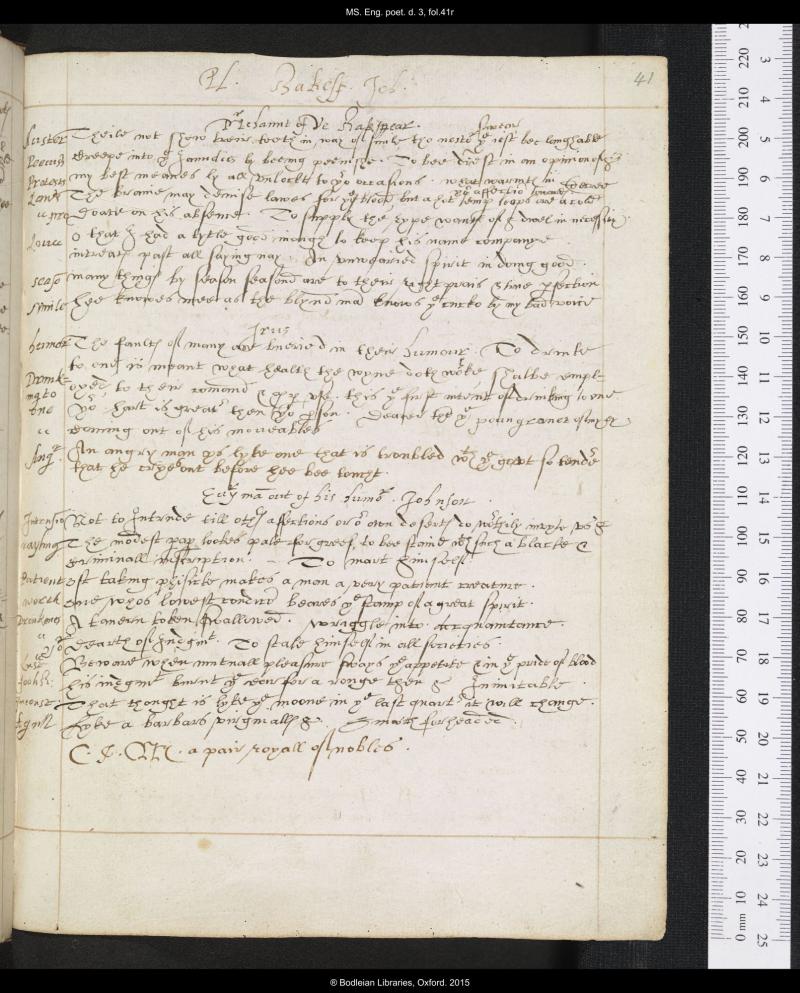
MS. Eng. poet. d. 3, folio 41 recto

View Image Assets
MS. Eng. poet. d. 3, folio 41 recto
Click image to enlarge

Institution Rights and Document Citation

Terms of use
The Bodleian Libraries, University of Oxford, has graciously contributed images of materials in its collections to Shakespeare Documented under the terms of a Creative Commons Attribution-NonCommercial 4.0 International licence.  Images used within the scope of these terms should cite the Bodleian Libraries as the source.  For any use outside the scope of these terms, visitors should contact Bodleian Libraries Imaging Services at imaging@bodleian.ox.ac.uk.

Document-specific information
Creator: Edward Pudsey
Title: Edward Pudsey's Commonplace book [portions]
Date: ca. 1600-1615
Repository: Bodleian Library, Oxford University, Oxford, UK
Call number and opening: MS. Eng. poet. d. 3, fols. 41, 86v

Semi-diplomatic transcription

Editorial note: In this transcription, marginal headings appear as their own line, preceeding the line of associated body text. As a result, the line of body text following a heading may include content associated with the previous heading.

                         Plays    shakespeare Iohnson
                         Merchannt of Venice Shakspear.
Luster    
Theil not shew vier teeth in way of smile tho nestor swear the rest bee laughable
Peeuish  
Creepe into the Iaundics by beeing peeuishe. To bee drest in an opinion of &c.
Protests  
my best meanes ly all vnlocked to your occasions. what warmth in        
                                                                                                 your affection towardes.
Laws      
The braine may devise lawes for thee blood, but a hot temper leaps ore a cold decree
"..o         
Doate on his absence. To supply the rype wants of &c. dwel in nesessity
Loue      
O that I had a tytle good inough to keep his name companye.
intreats past all saying nay. An vnwearied spirit in doing good.
season      
many thinges by season seasond are to their right prais & true perfection
simile     
Hee knowes mee as the blynd man knows the cucko by my bad voice
                                                              

                                              Irus
humor     
The faultes of many are bueried in their humour. To drinke
to one is meant what health the wyne doth worke shalbe empl=
Drink= 
ing to
one   
oyed, to their command & proper vse. this the first intent of drinking to one
your hart is greater then your person. Dearer then the poungranet of my ey
"Coming out of his moueables
Anger      
An angry man ys lyke one that is troubled with the govt so tender
                 that he cryes out before hee bee toucht.

                             Euery man out of his humor . Iohnson .
Intrusion  
Not to Intrude till others affections or our own desertes do worthily invyte vs &c.
raysing     
The modest paper lookes pale for greef, to bee staind with such a blacke &
Criminall inscription.              To marc himself
Patient      
Oft taking phisicke makes a man a very patient creature.
worth        
one whos lowest condicion beares the stamp of a great spirit.
Dronkenes
"A tauern token swallowed. wraggle into acquaintaince.
“your dearth of Iudgment. To stale himself in all societies.
Lust          
Beware when mutuall pleasure sways the appetite & in the pride of blood
foolish:     
his iudgment burnt the ear for a rouge then etc. Inimitable.
Inconst:    
That thought is lyke the moone in the last quarter it will change.
Agull        
Lyke a barbars virginalles &c. Smooth forheaded.

                     C.I.M a pair royall of nobles

Item Creator
Edward Pudsey
Item Title
Edward Pudsey's Commonplace book [portions]
Item Date
ca. 1600-1615
Repository
Bodleian Library, Oxford University, Oxford, UK
Call Number
MS. Eng. poet. d. 3, fol. 41r

MS. Eng. poet. d. 3, folio 41 verso

View Image Assets
MS. Eng. poet. d. 3, folio 41 verso
Click image to enlarge

Institution Rights and Document Citation

Terms of use
The Bodleian Libraries, University of Oxford, has graciously contributed images of materials in its collections to Shakespeare Documented under the terms of a Creative Commons Attribution-NonCommercial 4.0 International licence.  Images used within the scope of these terms should cite the Bodleian Libraries as the source.  For any use outside the scope of these terms, visitors should contact Bodleian Libraries Imaging Services at imaging@bodleian.ox.ac.uk.

Document-specific information
Creator: Edward Pudsey
Title: Edward Pudsey's Commonplace book [portions]
Date: ca. 1600-1615
Repository: Bodleian Library, Oxford University, Oxford, UK
Call number and opening: MS. Eng. poet. d. 3, fols. 41, 86v

Semi-diplomatic transcription

                                     Plays   Marston . Iohnson
                         Antonio & Mellida . ipart . Marston .
Affectacion 
Greedily Champing what any other wel valued iudgment had chewed
A flatter      
A supple chapt flatterer with most obsequious sleek-brow’d intertaine
"Husht obseraunce. A cheek not as yet  wan’d. with an intentiue thought
An eye        
"A smart speaking ey. Keele your mouth it runs ouer.
"Eloquence begins to grope him already.
                                    2 part of A:M.
Partiality    
"your ffauor will giue crutches to our ffaultes. hony me with fluent speech
Painting     
ffayrer then natures faire ys foulest vyce . Clingd in sensuallity.
Ignorance   
he that speakes he knows not what neuer sins against his own conscience
Plaines       
The clapper of his mouth is not glibd with court oyle swil not strike on
Lust            
both sydes yet. The least soyle of lust smeeres pure loue.
“Tronges of thoughtes crowd for passage. Lysen it       exit
Resolved
Steele the point of thy resolue that it turn not edg in execucion
“I affect with vnbounded zeale. And old man will seru for picking mait.
Patien.        
Patience hoop my sydes with steeled ribbes least I do burst my brestes
with strugling passions. unapparell your Dear beauties bl
"Statesmen that cleaue through knottes of Craggie pollicies
statistes
vse men lyke wedges one to stryke out an other till &c.
Flattery      
A Burre that stickes vppon mapp of greatnes.

                                         Poestaster.
Enuy    
The envyous haue Basiliske eys & forked tonges steept in
venom as their hartes in gall.  They haue salt in them and
                                                                          will brooke the ayre. 
Ignoranc  
The spawne of ignorance may bestime his name &c.
                                                    Distorted faces & dudgeon censures
Co:Law      
O that I studie not the tedious lawes, & prostitute my voic in eny cause
“Enuy, the liuing not the dead doth byte. for after death all men receiu their ryght.
Selfwill      
Let not your ears bee dammd vp to all good counsell.
“The tyme was once when wit drownd welth:but now your only barba=
“rism's, to haue witt & want. No matter now who in
“vertue excells, be that hath coyn hath all perfection else
“yt wold haue crackt our sinews shrunk our vains, & made our very hart
"strings iar &c . ffulsome to mee in euery thing &c.
“moues as mightelye. A man born vpon little legges is always a gentleman borne

Item Creator
Edward Pudsey
Item Title
Edward Pudsey's Commonplace book [portions]
Item Date
ca. 1600-1615
Repository
Bodleian Library, Oxford University, Oxford, UK
Call Number
MS. Eng. poet. d. 3, fol. 41v

MS. Eng. poet. d. 3, folio 86 verso

View Image Assets
MS. Eng. poet. d. 3, folio 86 verso
Click image to enlarge

Institution Rights and Document Citation

Terms of use
The Bodleian Libraries, University of Oxford, has graciously contributed images of materials in its collections to Shakespeare Documented under the terms of a Creative Commons Attribution-NonCommercial 4.0 International licence.  Images used within the scope of these terms should cite the Bodleian Libraries as the source.  For any use outside the scope of these terms, visitors should contact Bodleian Libraries Imaging Services at imaging@bodleian.ox.ac.uk.

Document-specific information
Creator: Edward Pudsey
Title: Edward Pudsey's Commonplace book [portions]
Date: ca. 1600-1615
Repository: Bodleian Library, Oxford University, Oxford, UK
Call number and opening: MS. Eng. poet. d. 3, fols. 41, 86v

Semi-diplomatic transcription

                       PLays Loues metamorphosis   Lilly & Alexander  & campasbe his
                               Titus Andronicus          Romeo & Iuliet
"The next blowe hittes the tale out of his mowth : her eys sunke so farre into
“her head that she looketh out of the nape of her neck: where continu=
Loue
virginity
all warre that betweene loue & vertue there must bee some parlies
& continuall perilles. Cupid was neuer conquered & therefore must bee
flattered, virginity hath & therefore must bee humble The Causes
Loue    
of loue witt & Idlenes, the meanes oportunity & Importunitye
ffor an other to put thoughtes into my head were to pull the brains out of my head
Poets make their wreathes of lawrell adyes of sunndry flowers.
Merchandise
A Merchant who knowes no other good then gold unles it bee falseye
wearing by a god to get golde.
beleef
my thoughtes are bound prentises to your wordes &c.
Alexander  
& Campasbe
A quipp ys a short saying of a sharp witt with a bitter sence in a sweet worde
Let her past. Response. so she shall for the fayrest in death.
“So light a body harth eaten nothing this seunnight but Cork & ffeatheres
Excues
“vsuall excuses the swearing Cometh of a whot mettle lying of a
“quick witt: fflattery of a flowing toung: vndecent talk of a mery disposicion /.
plaines
To be beleeved whet your toung on your hart.
“down with arms & vp with &c.
                     Titus Andronicus .
Mercye
Yf thou wilt draw neuer the nature of the godes, bee mercifull &c.
“Shall flyle & trim our devises
“had I but seene thy picture in this plight, yt wold &c.
                                                       Romeo & Iuliet
Loue
ffeather of lead, bright smoake cold fyer, sicke health, still waking sleep &c.
“If I see one passing fair, yt is to mee but as a note wher I read
“who past that passing faire.
Tut man one fyre burnes out anotheres burninge one paine ys less=
ened by anotheres anguish, turne giddy & be holy by backwarde
turninge: Take you som new infection to thy eye & the rank poson of the old will dye.
I care not what curious eye doth cote deformityes.
"when good manneres shall lye all in one or 2 mens handes & they
"vnwasht too, tis a foule thinge. the whyte vpturned wondring eys
Beauty
O she doth teach the torches to burne bright she hanges vppon the cheek
of night lyke a ruh Iewell in an Ethiops eare: Two of the fayrest starres
in all the heauen hauing som buesines do intreat her eys to twinke in
their spheeres till they returne. my eares haue not yet dronk a 100 wordes
of that tounges vtterance, yet I shold know it
Loue  
Loue goes toward Loue as schoole boyes from thier bookes
but Loue from Loue towards schoole with heauvy Lookes

Item Creator
Edward Pudsey
Item Title
Edward Pudsey's Commonplace book [portions]
Item Date
ca. 1600-1615
Repository
Bodleian Library, Oxford University, Oxford, UK
Call Number
MS. Eng. poet. d. 3, fol. 86v

Institution Rights and Document Citation

Semi-diplomatic transcription

Last updated February 3, 2020

Pilgrimage to Parnassus and Return from Parnassus: multiple references to Shakespeare

Document Images

MS. Rawl. D. 398, folio 214 verso

View Image Assets
MS. Rawl. D. 398, folio 214 verso
Click image to enlarge

Institution Rights and Document Citation

Terms of use
The Bodleian Libraries, University of Oxford, has graciously contributed images of materials in its collections to Shakespeare Documented under the terms of a Creative Commons Attribution-NonCommercial 4.0 International licence.  Images used within the scope of these terms should cite the Bodleian Libraries as the source.  For any use outside the scope of these terms, visitors should contact Bodleian Libraries Imaging Services at imaging@bodleian.ox.ac.uk.

Document-specific information
Title: "The Pilgrimage to Parnassus," and "The Return from Parnassus;" two comedies. 
Date: 1598-1601
Repository: Bodleian Library, Oxford University, Oxford, UK
Call number and opening: Rawl. D. 398, item 72, fols. 214v, 215r, 216v

Semi-diplomatic transcription

                             ragged companions I reward the poore ergoes moste boun=
                             tifullie, and send them away, I am verie latelie registred
                             in the roules of fame, in an Epigram made by a Cam=
                             bridge man our weauer fellow I parraut him, els
                             could he never haue had such a quick sight into my
                             ventures, howsoeuer I merit his praise: if I meet with him
                             I will vouchsafe to giue him condigne thankes.
                Ingen.   Great reason the Muses shoulde flutter about youre
                             immortall heade since your bodye is nothinge but a faire
                             Inne of fairer guestes that dwell therin, but you haue
                             digrest from your Mris, for whose sake you & I began
                             this parley
                Gullio.  Marrie well remembred, Ile repeat vnto you an enthu=
                             siasticall oration, wherwith my new Mistress ears were
                             verie lately made happie. the carriage of my body by
                             the reporte of my mistriss was excellent . I stood stroking
                             vp my haire, which became me very admirably, saue alow
                             cong.y at the beginninge of each period made euery
                             sentence end sweetly with an othe . It is part of an
                             Oratoure to persvade, & I know not how better , than
                             to conclude with such earnest protestations. suppose also
                             that thou wert my Mris as somtime woodde statues repre=
                             sent the goddesses, thus I woulde looke amorously, thus
                             I would pace, thus I woulde salute Her.
                Ingen.   It will be my lucke to dye noe other death, than by
                             hearinge of his follies, I feare this speach thats a comminge
                             will breede a deadly disease in my ears .
                Gullio.  Pardon faire Lady, thoughe sicke thoughted Gullio maks
                             a maine vnto thee, & like a bould faced sutore gins to woo
                             thee.
                Ingen.   we shall haue nothinge but pure Shakspeare, and shreds of
                             poetrie that he hath gathered at the theators.
                Gullio.  Pardon mee moy mittressa, as I am a gentleman the moone
                             in comparison of thy bright hue a meere slutt, Anthonies
                             Cleopatra a blacke browde milkmaide, Hellen a dowdie
                 Ingen:  Marke Romeo, and Iuliet. o monstrous theft I thinke he
                             will runn throughe a whole booke of Samuell Daniells
                 Gullio  Thrise fairer than my selfe, thus I began
                             the gods faire riches sweete aboue compare
                             staine to all Nimphes, ore louely the a man
                             More white and red than doues and roses are
                             Nature that made thee with herselfe had strife
                             faith that the worlde hath ending with thy life.
                Ingen:   Sweete Mr Shakspeare.
                Gullio   As I am a scholler these arms of mine are long and
                             strong withall.
                             Thus elms by vines are compast ere they falle.
                Ingen:   faith gentleman youre reading is wonderfull in our English
                             poettes.
                Gullio.  Sweet Mistress I vouchsafe to take some of there wordes and
                             applie them to mine owne matters by a scholasticall
                             imitation, Report thou vpon thy credit is not my vayne
                             in courtinge gallant, & honorable?
                Ingen:   Admirable sanes compare, neuer was soe mellifluous a witt
                             ioynet to so pure a phrase, such comly gesture, suche
                             gentleman like behauiour.
                Gullio   But stay ites verie true, good wittes haue badd memories
                             I had almoste forgotten the cheife pointe I cald thee out
                             for new years day approcheth, and wheras other gallantes
                             bestowe Jewells vpon there mistrisses (as I haue done
                             whilome) I now count it base. to do as the common people
                             doe, I will bestow vpon them the precious stons of my
                             witt a diamonde of invention, that shall be aboue all
                             value, & esteeme, therfore sithens I am employed in some
                             weightie affayrs of the courte I will haue thee Ingenioso
                             to make them, and when thou hast done, I will peruse
                            pollish, and correcte them /
                                                                                                           my

Item Title
"The Pilgrimage to Parnassus," and "The Return from Parnassus;" two comedies.
Item Date
1598-1601
Repository
Bodleian Library, Oxford University, Oxford, UK
Call Number
MS. Rawl. D. 398, fol. 214v

MS. Rawl. D. 398, folio 215 recto

View Image Assets
MS. Rawl. D. 398, folio 215 recto
Click image to enlarge

Institution Rights and Document Citation

Terms of use
The Bodleian Libraries, University of Oxford, has graciously contributed images of materials in its collections to Shakespeare Documented under the terms of a Creative Commons Attribution-NonCommercial 4.0 International licence.  Images used within the scope of these terms should cite the Bodleian Libraries as the source.  For any use outside the scope of these terms, visitors should contact Bodleian Libraries Imaging Services at imaging@bodleian.ox.ac.uk.

Document-specific information
Title: "The Pilgrimage to Parnassus," and "The Return from Parnassus;" two comedies. 
Date: 1598-1601
Repository: Bodleian Library, Oxford University, Oxford, UK
Call number and opening: Rawl. D. 398, item 72, fols. 214v, 215r, 216v

Semi-diplomatic transcription

                   Ing       My pen is youre bounden vassall to commande but what
                               vayne woulde it please you to haue them in
                   Gullio   Not in a varie veine (pretlie y faith) make mee them
                               in two or three diuers vaynes in Chaucers, Gowers
                               and Spencers, and Mr Shakspeares, Marry I thinke
                               I shall entertaine those verses which run like these
                                         Even as the sunn with purple coloured face
                                               had tane his laste leaue on the weeping morne .etc.
                               O sweet Mr Shakspeare, Ile haue his picture in my
                               study at the courte.
                   Ingen:  Take heede my maisters hele kill you with tediousness
                               ere I can ridd him of the stage.
                   Gullio   Come let vs in Ile eate a bit of phesante & drincke
                               a cupp of wine in my cellar, & straight to the courte
                               Ile goe a count els and twoo Lordes expect mee
                               to day at dinner they are my very honorable
Enter Leonard          frendes I muste not disapointe them.
and Consiliodorus
               Leonard    Mr Cousiliodorus are you with in? god be here.
                  Consil:   What Leonarde, fill vs a cupp of beare for Leonard
                               what good news Leonarde?
              Leonarde   Oh I haue had great affliction since I sawe you
                                laste.Tib is fallen sore sicke of the Glanders,
                                and dun poore iade, I thinke he hath eaten a feather
                                but I haue letters for youe, and as manie commen=
                                dacions as there are greene grass betwixt you
                                and them, I told them of their hauioure I
                                warrant youe. I tolde them howe costlie there
                                nutreringe was, and they might by this time
                                if they had bene good boyes haue learned all
                                there bookes I chid them ronndlie without bawking
                                foor blowing at Tabecca, I toulde them plainely
                                it was nothing but a docke leafe, stept in a cham=
                                ber pott . and by cocke Mr. Consiliodorus I did
                                such good vpon them , that I thinke by this time
                                they are gone into the cuntrie to teache I
                                warrant Mr Philomusus will proue a greate clarke
                                he is such a readye man of his tongue, yet I
                                thinke Mr. Studioso is as well booklearned as he is
                  Consili:  I pray thee Leonarde goe in, and eate a bit of meate
                                Ile followe thee straighte.
               Leonard   God thanke youe Mr wee that are stirringe be=
                                times haue good stomackes, but Ile firste leade
                                my horses to the hay racke, they poore Iades are as
                                shallowe as a cloakbagg.
             Consiliod:   Hencforthe let none be sent by carefull syres
                                nor sonns no kinred to Parnassus hill
                                Since waywarde fortune thus rewardes our coste
                                with discontent, theire paines with pouertie
                                Mechanicke artes may smile, there followers laughe
                                but liberall artes Bewaile there destinie
                                since noe Mocenas in this niggard age
                                Guerdons they sonns of Muses, and of skill
                                My ioyless minde foretells this sad event
                                That learning needs muste leaue this duller clime
                                to be possest by rude simplicitie.

Item Title
"The Pilgrimage to Parnassus," and "The Return from Parnassus;" two comedies.
Item Date
1598-1601
Repository
Bodleian Library, Oxford University, Oxford, UK
Call Number
MS. Rawl. D. 398, fol. 215r

MS. Rawl. D. 398, folio 216 verso

View Image Assets
MS. Rawl. D. 398, folio 216 verso
Click image to enlarge

Institution Rights and Document Citation

Terms of use
The Bodleian Libraries, University of Oxford, has graciously contributed images of materials in its collections to Shakespeare Documented under the terms of a Creative Commons Attribution-NonCommercial 4.0 International licence.  Images used within the scope of these terms should cite the Bodleian Libraries as the source.  For any use outside the scope of these terms, visitors should contact Bodleian Libraries Imaging Services at imaging@bodleian.ox.ac.uk.

Document-specific information
Title: "The Pilgrimage to Parnassus," and "The Return from Parnassus;" two comedies. 
Date: 1598-1601
Repository: Bodleian Library, Oxford University, Oxford, UK
Call number and opening: Rawl. D. 398, item 72, fols. 214v, 215r, 216v

Semi-diplomatic transcription

                                leaue, but litell learninge behinde mee vpon the eathe
                                well those verses haue purchast my implacable anger lett
                                mee heare youre other vayns.

                    Ingen:  Sir the worde as Chaucer vseth it, hark noe vnhonest
                                meaninge in it, for it signifieth a ieste.

                    Gullio   Hush Chaucer is a foole, and you are another for defendinge
                                of him.

                  Ingen:    Then you shall heare Specers veyne.
                                A gentle pen rides prickinge on the plaine

                                this paper plaine to resalute my loue
                    Gullio   Stay man, why thou haste a very lecherous witt, what

                                wordes are these ? though thou comes somwhat neare
                                witt to sett it downe soe plainlye, youe schollers

                                are simple felowes, men that never came where Ladies
                                growe, I that haue spente my life amonge them

                                knowes best what becometh my pen, and their Ladi=
                                shipps ears, let mee heare Mr Shakspears veyne .

                   Ingen:   Faire Venus queene of beutie, and of loue
                                thy red doth stayne the blushinge of the morne

                                thy snowie neck shameth the milke white doue
                                thy presence doth this naked worlde adorne

                                Gazinge on thee all other nymphes I scorne
                                when ere thou dyest slowe shine that satterday

                                Beutie and grace muste sleepe with thee for aye.
                   Gullio    Noe more I am one that can iudge accordinge to the proverbe

                                bonem ex vnguibus, ey marry Sir these haue some
                                life in them, let this dunissied world esteeme of Spencer

                                and Chaucer, Ile worshipp sweet Mr Shakspeare, and to
                                honoure him will lay his Venus, and Adonis vnder my

                                pillowe as wee reade of one (I do not well remember his
                                name) but I am sure he was a kinge, slept with Homer

                                vnder his beds heade well Ile bestowe a  frenche
                                crowne in the fair writinge of them out and then

                                Ile instructe thee about the deliuery of them, meane
                                while, Ile haue thee make an elegant description of

                                my Mistress, liken the worste part of her to Cynthhia
                                make also a familiar Dialogue betwixt her, and my

                                selfe, Ile now in, and correct these verses.
                   Ingen:   Why who coulde endure this post put into a sattin sute

                                this haberdasher of lyes, this Bracchidochio, this Ladye
                                munger, this meere rapier, and dagger, this cringer,

                                this foretopp, but a man there ordaynd to miserie
                                well madame pecunia, onc more for thy sake will

                                I waite on this truncke, and with soothinge him vpp
                                in time will leaue him a greater foole than I

                                founde him.      exit
         Enter warden

                                Mass maisters the case is alterd with mee since I
                                was here laste, they call mee noe more plaine Will

                                nor William, nor goodman Percevall, but Mr war=
                                den at euerye worde, well if yee please mee well

                                you may happ make the bells speake somtime for
          Enter Philo:     this. but stay I seeke our Sexton, and yonder he

                                is. Now good Sexton, I am as tirde as anye of my
                                pluge iades with enquiringe you. you shoulde haue

                                pearde for Mr Maior his maistershipp, for wott
                                you what. the parish haue put vp a subligation
                                against you, & say you are the moste vnnegligent
                                Sexton that euer came these 40 years, and vpwardes
                                                                                                            for

Item Title
"The Pilgrimage to Parnassus," and "The Return from Parnassus;" two comedies.
Item Date
1598-1601
Repository
Bodleian Library, Oxford University, Oxford, UK
Call Number
MS. Rawl. D. 398, fol. 216v

Institution Rights and Document Citation

Semi-diplomatic transcription

Last updated February 8, 2020

Henry VI Part 3, first edition

Document Images

Arch.G f.1, title page

View Image Assets
Arch.G f.1, title page
Click image to enlarge

Institution Rights and Document Citation

Terms of use
The Bodleian Libraries, University of Oxford, has graciously contributed images of materials in its collections to Shakespeare Documented under the terms of a Creative Commons Attribution-NonCommercial 4.0 International licence.  Images used within the scope of these terms should cite the Bodleian Libraries as the source.  For any use outside the scope of these terms, visitors should contact Bodleian Libraries Imaging Services at imaging@bodleian.ox.ac.uk.

Copy-specific information
Creator:
William Shakespeare
Title: The true tragedie of Richard duke of Yorke, and the death of good king Henrie the sixt, with the whole contention betweene the two houses Lancaster and Yorke, as it was sundrie times acted by the earle of Pembrooke his seruants.
Date: Lond. P.S. for T. Millington, 1595
Repository: Bodleian Library, Oxford University, Oxford, UK
Call number and opening: Arch.G f.1, title page
View online bibliographic record

Item Creator
William Shakespeare
Item Title
The true tragedie of Richard duke of Yorke, and the death of good king Henrie the sixt, with the whole contention betweene the two houses Lancaster and Yorke, as it was sundrie times acted by the earle of Pembrooke his seruants.
Item Date
Lond. P.S. for T. Millington, 1595
Repository
Bodleian Library, Oxford University, Oxford, UK
Call Number
Arch.G f.1, title page

Institution Rights and Document Citation

Last updated April 26, 2020

Henry VI Part 2, second edition

Document Images

Arch.G e.14, title page

View Image Assets
Arch.G e.14, title page
Click image to enlarge

Institution Rights and Document Citation

Terms of use
The Bodleian Libraries, University of Oxford, has graciously contributed images of materials in its collections to Shakespeare Documented under the terms of a Creative Commons Attribution-NonCommercial 4.0 International licence.  Images used within the scope of these terms should cite the Bodleian Libraries as the source.  For any use outside the scope of these terms, visitors should contact Bodleian Libraries Imaging Services at imaging@bodleian.ox.ac.uk.

Copy-specific information
Creator: William Shakespeare
Title: The first part of the Contention betwixt the two famous houses of Yorke and Lancaster [by W. Shakespeare.].
Date: Lond. V. Simmes for T. Millington, 1600
Repository: Bodleian Library, Oxford University, Oxford, UK
Call number and opening: Arch.G e.14, title page
View online bibliographic record

Item Creator
William Shakespeare
Item Title
The first part of the Contention betwixt the two famous houses of Yorke and Lancaster [by W. Shakespeare.].
Item Date
Lond. V. Simmes for T. Millington, 1600
Repository
Bodleian Library, Oxford University, Oxford, UK
Call Number
Arch.G e.14, title page

Institution Rights and Document Citation

Last updated April 25, 2020

Richard II, fourth edition variant

Document Images

Arch.G d.43 (1), title page

View Image Assets
Arch.G d.43 (1), title page
Click image to enlarge

Institution Rights and Document Citation

Terms of use
The Bodleian Libraries, University of Oxford, has graciously contributed images of materials in its collections to Shakespeare Documented under the terms of a Creative Commons Attribution-NonCommercial 4.0 International licence.  Images used within the scope of these terms should cite the Bodleian Libraries as the source.  For any use outside the scope of these terms, visitors should contact Bodleian Libraries Imaging Services at imaging@bodleian.ox.ac.uk.

Copy-specific information
Creator: William Shakespeare
Title: The tragedie of King Richard the second, with new additions of the parliament sceane, and the deposing of king Richard, as it hath been lately acted by the kinges maiesties seruantes, at the Globe.
Date: Lond. W.W. for M. Law, 1608
Repository: Bodleian Library, Oxford University, Oxford, UK
Call number and opening: Arch.G d.43 (1), title page
View online bibliographic record

Item Creator
William Shakespeare
Item Title
The tragedie of King Richard the second, with new additions of the parliament sceane, and the deposing of king Richard, as it hath been lately acted by the kinges maiesties seruantes, at the Globe.
Item Date
Lond. W.W. for M. Law 1608
Repository
Bodleian Library, Oxford University, Oxford, UK
Call Number
Arch.G d.43 (1), title page

Institution Rights and Document Citation

Last updated January 25, 2020

Elias James epitaph, attributed to Shakespeare

Document Images

MS. Rawl. Poet. 160, folio 41 recto

View Image Assets
MS. Rawl. Poet. 160, folio 41 recto
Click image to enlarge

Institution Rights and Document Citation

Terms of use
The Bodleian Libraries, University of Oxford, has graciously contributed images of materials in its collections to Shakespeare Documented under the terms of a Creative Commons Attribution-NonCommercial 4.0 International licence.  Images used within the scope of these terms should cite the Bodleian Libraries as the source.  For any use outside the scope of these terms, visitors should contact Bodleian Libraries Imaging Services at imaging@bodleian.ox.ac.uk.

Document-specific information
Creator: [Shakespeare, William]
Title: An epitaph on Elias James
Date: ca. 1640
Repository: Bodleian Library, Oxford University, Oxford, UK
Call number and opening: MS. Rawl. Poet. 160, fol. 41 

Semi-diplomatic transcription

[fol. 41r]

Shine o’re thy hearse; the breath of our Iust praise
Shall to the firmanent thy virutes praise
Then fixe & kindle them into a star
Whose Influeuce may crown they glorious war
                                                            Hen:King

                          IN
             Obitum filis domini Rich:
                  Anderson milites:

Faire peice of Angell gold that wert yet hot
Out of heavens mint & had’st not long since got
Thy Soveraignes Image on thee, & found true
Without allowance for all graines were due
To a young goodnes that the fate hast found
Of misers gold to be intomb’d in ground
Go dainty wormes meat, if such things as they
Got of their food can breed here for we may
Think such a flesh Corrupted in the mold
Without the ayd of balme & Aloes would
A richer mummy make thou ere was sent
From a time worne Egiptian monument
Go pretty soule now cut in heaveen, & set
As a rich diamond in an Ammulet
Which now is broken & the severed Iem
Shines with the stones in new Hierusalem
And if the soule be made of harmony
As tis defin’d in some philosophy
He shall so sing none shall distinguish him
Suppos’d to be some pretty Cherubin . /

                    AN
                Epitaph

When god was pleasd, the world vnwilling yet
Elias James to nature payd his debt
And here reposeth: as he liv'd he dyde
The saying in him strongly verefide
Such life such death then the known truth to tell
he liv’d a godly life and dy’de as well /.
                                                William Shakespeare

Item Creator
[Shakespeare, William]
Item Title
An epitaph on Elias James
Item Date
ca. 1640
Repository
Bodleian Library, Oxford University, Oxford, UK
Call Number
MS. Rawl. Poet. 160, fol. 41r

Institution Rights and Document Citation

Semi-diplomatic transcription

Last updated February 3, 2020

Pages