To view a sortable list, please visit the Resource
All Documents

1594
Shakespeare’s Lucrece was first printed in 1594, fulfilling his promise to the earl of Southampton in the 1593 dedication to Venus and Adonis of “some grauer labour.” In the dedicatory epistle to Lucrece, which was likewise

1594
The first known printed reference to Shakespeare appears in a commendatory poem introducing the poetry collection Willobie his Avisa, printed in 1594. The poem, entitled “In praise of Willobie his Avisa, Hexameton to the Author,” appears before the main text.
1595
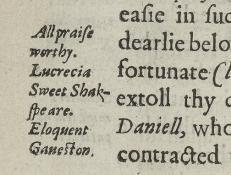
In 1595 William Covell, a church of England clergyman and a fellow of Queen’s College in Cambridge, wrote Polimanteia, which was produced by John Legate, the Cambridge University printer.
1595
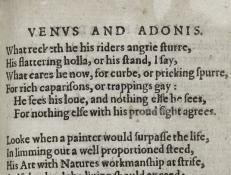
This is the only known surviving copy of the third edition of Venus and Adonis, Shakespeare’s first printed work. It is a heavily-repaired fragment, with the first section now lost.
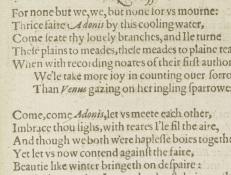
1595
SHAKESPEARE DOCUMENTED IS STILL GROWING! Descriptive content and transcriptions will continue to be added, updated and expanded. Check back for regular updates!
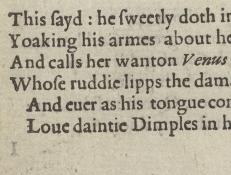
1595
Like Shakespeare’s Sonnets, first printed in 1609, Richard Barnfield’s sonnet sequence Cynthia (1595) was accompanied by a narrative complaint.
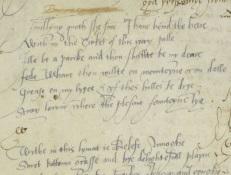
ca. 1596
Henry Colling, who attended Cambridge but left without a degree in the early 1580s, transcribed two stanzas of Venus and Adonis into this small folio of historical tracts (lines 229&ndas

1596
The fourth edition of Shakespeare's popular narrative poem Venus and Adonis was published in 1596, three years after the first edition. This fourth edition was the last to be printed by Richard Field and sold by John Harrison.

June 25, 1596
On June 25, 1596, the London printer and publisher John Harrison the Elder transferred his rights to print Shakespeare's poem Venus and Adonis to his colleague, William Leake, who printed the fifth edition in 1599.

ca. 1598
The scholar and writer Gabriel Harvey was known and mocked in his lifetime for making copious notes in the margins of printed books. An inventor of words, friend of Edmund Spenser, and rival of Thomas Nashe, he constantly sought to improve himself through note-taking and repetitive reading.